

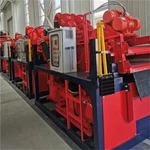

Hey there! As a desander supplier, I often get asked about the best installation positions for desanders in a pipeline system. It's a crucial topic because the right placement can significantly impact the efficiency and performance of the desander. So, let's dive right into it!
Upstream of Pumps
One of the common installation positions for a desander is upstream of pumps. When you place the desander before the pump, it acts as a protective barrier. You see, sand and other solid particles can be pretty harsh on pumps. They can cause abrasion to the pump impellers, casings, and other internal components. Over time, this abrasion can lead to reduced pump efficiency, increased energy consumption, and even premature pump failure.
By installing a Mud Desander or Slurry Desander upstream of the pump, we can remove a large portion of these solid particles. This way, the pump only has to deal with a cleaner fluid. For example, in a water supply system where the water source might contain sand from the ground, putting a desander before the pump will ensure that the pump operates smoothly for a longer time. It's like giving your pump a shield against the damaging effects of sand.
After the Inlet and Before Main Process Equipment
Another great spot to install a desander is right after the inlet of the pipeline system and before the main process equipment. In many industrial processes, the incoming fluid might carry a significant amount of sand and debris. This could be in a mining operation where slurry is being transported, or in an oil and gas field where the produced fluid may contain sand from the reservoir.
If these solid particles are allowed to reach the main process equipment, they can cause all sorts of problems. They might clog up the equipment, reduce its efficiency, and even lead to production downtime. By installing a desander at this position, we can prevent these issues. The desander will separate the sand and other solids from the fluid, ensuring that only clean fluid enters the main process equipment. This is especially important in processes where the equipment is sensitive to the presence of solids, such as in some chemical manufacturing processes.
At Branch Points in the Pipeline
Branch points in a pipeline system are also good locations for desander installation. When a pipeline branches off, the flow characteristics change, and there's a higher chance of sand and solids accumulating at these points. If not removed, these solids can cause blockages in the branch pipelines, leading to uneven flow distribution and potential damage to the equipment connected to the branches.
Installing a desander at the branch point helps to keep the flow clean and smooth. It can capture the sand and solids that might otherwise get trapped at the branch, ensuring that each branch receives a proper supply of clean fluid. For instance, in a large irrigation system where the main pipeline branches off to supply water to different fields, a desander at each branch point can prevent clogging of the irrigation nozzles and ensure uniform water distribution.
Near the Outlet of High-Velocity Sections
High-velocity sections in a pipeline can cause sand and other solids to be carried along with the fluid more easily. When the fluid reaches the end of these high-velocity sections, there's a sudden change in flow conditions, which can lead to the deposition of solids. This is why it's a good idea to install a desander near the outlet of high-velocity sections.
The desander can capture the solids that are about to settle at this point. By doing so, it prevents the formation of sediment deposits in the pipeline, which can reduce the flow capacity and increase the pressure drop. In a pipeline that transports slurry at high speeds, such as in a dredging operation, a desander near the outlet of the high-velocity section can keep the pipeline clear and maintain efficient operation.
Considerations for Installation
When deciding on the installation position of a desander, there are several factors to consider. First of all, the flow rate of the fluid in the pipeline is crucial. You need to make sure that the desander can handle the flow rate without causing excessive pressure drop. If the flow rate is too high, the desander might not be able to separate the solids effectively, and if it's too low, the desander might not be fully utilized.
The size and type of the solids in the fluid also matter. Different desanders are designed to handle different sizes of particles. For example, a hydrocyclone desander is more effective for removing smaller particles, while a gravity-based desander might be better for larger particles. You need to choose the right type of desander based on the characteristics of the solids in your fluid.
The available space in the pipeline system is another important consideration. Some desanders are quite large and require a significant amount of space for installation. You need to ensure that there's enough room to install the desander and also to perform maintenance and inspection tasks.
Conclusion
In conclusion, choosing the right installation position for a desander in a pipeline system is essential for its proper functioning. Whether it's upstream of pumps, after the inlet and before main process equipment, at branch points, or near the outlet of high-velocity sections, each position has its own advantages.
As a desander supplier, I'm here to help you find the best solution for your specific needs. If you're looking for a reliable Mud Desander or Slurry Desander, and want to discuss the installation positions and other details, don't hesitate to reach out. We can work together to ensure that your pipeline system operates efficiently and smoothly.


References
- Smith, J. (2020). Pipeline System Optimization. Industrial Press.
- Johnson, A. (2019). Desander Technology and Applications. Journal of Fluid Handling.