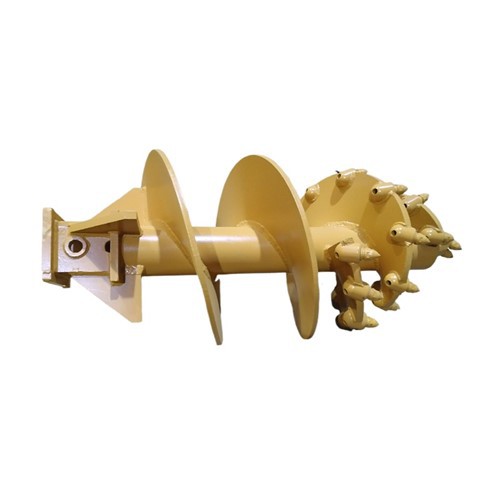
A drilling auger, also known as an earth auger or post-hole auger, is a tool that drills holes into the ground or other materials using a spiral-shaped bit that resembles a screw. The bit has curved flights that rotate as the drill head applies pressure, driving the bit deeper into the ground.
Main Products
Mainly manufacture drilling bucket,auger,core barrel,cleaning bucket,casing tube,drilling bits,kelly bar,desander,pile breaker,tremie pipes etc.
Specialized Processing and Equipments
Raw material comes from the biggest supplier of steel plate in China.
4-Rolls CNC rolling machine,max rolling thickness 70mm and width 3200mm,rolling error of one.
Cases
Our products have been sold more than 60 countries and regions:USA,Australia,Canada,New Zealand,Russia,Brazil,Mexico,South East Asia, Bangladesh,Africa etc.
Advanced equipment
We have the most advanced production equipment such as rolling machine, vertical lathe, CNC automatic boring and milling machine.
Common Drilling Auger Sizes
2 To 4 inches
Perfect for gardening, you can use these augers to plant small items such as bulbs, grass plugs, veggies, or smaller plants.
5 To 7 inches
Can be used to dig small post holes, as well as in the garden for larger, gallon-sized plants or small trees and bushes. At the 7-inch end of the scale, you can drill 4-by-4 post holes. A 6-inch auger can be useful for drilling holes for steel posts measuring 1 7/8 inches or 2 3/8 inches.
8 To 9 inches
For digging fence posts or mailbox holes and holes for larger plants. Capable of drilling holes for 6-by-6 posts. This size auger will work well for providing fill space for cement to anchor a post in place.

Ice Auger
There are a few applications for ice augers–and that’s drilling holes into ice and crushing ice. The blades in this device are designed, sharpened, and shaped for ice cutting and crushing. These are commonly used in commercial or industrial food equipment to crush ice for food and drinks. Ice augers are also used for ice fishing, however can be used any time you need to drill through a thick layer of ice.
Earth Auger
Earth augers are used for making holes in the ground and are built with a rotating metal pipe or rod with one or more blades attached at the lower end. As suggested by the name, an earth auger is designed to cut or scrape through ground and soil. These augers are commonly used in the agriculture industry by farmers and gardeners who are planting crops.


Grain Auger
The purpose of a grain auger is to transport large amounts of grain. A grain auger is built with a large tube containing a solid shaft with the flighting spiraling around it, counterclockwise.
Garden Auger
Garden augers look very similar to industrial augers; however, they are usually handheld, lightweight, and are considerably more affordable. They’re used to dig fence post holes, plant bulbs/grass plugs, and other gardening/landscaping purposes.

Clay formations: Augers are well-suited for drilling through clay formations, which are common in many parts of the world. The spiral shape of the auger allows it to penetrate and remove clay efficiently, making it an ideal choice for projects involving clay soils.
Sand and gravel formations: Augers can easily drill through sand and gravel formations, which are often encountered in coastal or riverine environments. The ability of an auger to continuously drill through obstructions makes it very easy to tackle these types of formations.
Rock formations: Augers can be used to drill through solid rock formations, including limestone, sandstone, and granite. The tool's ability to apply high torque and pressure allows it to penetrate even the hardest rock formations.
Glacial till formations: Augers can be used to drill through glacial till formations, which are common in areas that were glaciated during the last ice age. Especially countries in the northern and southern hemispheres close to the polar regions often use augers.
Karst formations: Augers can be used to drill through karst formations, which are characterized by soluble rocks such as limestone and dolomite.The sharp alloy teeth of the auger can easily cut limestone in karst terrain, doubling the drilling efficiency of the drill.
Agriculture
Augers are used for planting crops, moving grain, and drilling holes for fence posts. Grain augers, in particular, are vital during harvest time to transfer large quantities of grain efficiently.
01
Construction
In construction, rock augers are used to create holes for foundations, poles, and other structural supports. They help in drilling through soil and rock, making the construction process quicker and more efficient.
02
Gardening
Gardeners use hand augers to plant bulbs, aerate the soil, and install small posts. They provide a straightforward and effective way to perform various gardening tasks without damaging the surrounding plants.
03
Ice Fishing
Ice augers allow fishermen to drill holes in frozen lakes to fish during winter. These augers are designed to cut through thick ice quickly, providing easy access to the water below.
04

While augers are a valuable tool in construction, they can also pose safety risks if not operated properly. To ensure safe operation, it is essential to follow proper safety protocols, including:
Wearing personal protective equipment (PPE) such as hard hats, safety glasses, and gloves.
Ensuring the drilling rig or excavator is properly maintained and in good working condition.
Conducting regular inspections of the auger and drilling equipment to ensure they are in good condition.
Following proper drilling procedures, including starting and stopping the auger gradually to avoid sudden movements.
Ensuring the work area is clear of obstacles and debris to prevent accidents.
Enhanced Material Composition
Manufacturers are constantly researching and developing new materials with superior hardness, toughness, and thermal stability. Advanced alloys and composite materials are being incorporated into rock auger bit construction, enhancing wear resistance and overall durability.
Precision Engineering
Modern manufacturing techniques, such as computer-aided design (CAD) and computer numerical control (CNC) machining, enable the production of rock auger bits with intricate geometries and precise tolerances. This precision engineering results in optimal cutting performance and extended tool life.
Innovative Cutting Mechanisms
Engineers are exploring innovative cutting mechanisms, such as diamond impregnated bits and rotary percussion drilling systems, to improve drilling efficiency in hard rock formations. These cutting-edge technologies offer enhanced penetration rates and reduced energy consumption, revolutionizing rock drilling operations.
Speed and Efficiency
One of the primary advantages of continuous flight auger drilling is its exceptional speed and efficiency. Unlike traditional drilling methods with multiple stages—drilling, casing installation, and grout or concrete placement—CFA drilling combines all these steps into a single process.
Improved Accuracy
Continuous flight auger drilling is renowned for its accuracy. The drilling technique leverages real-time computer monitoring systems, which provide constant feedback on parameters like depth, speed, and torque. This data allows operators to make immediate adjustments, ensuring the drilling process stays on target.
Better Ground Stability
The continuous flight auger drilling process is a highly effective technique that is crucial in maintaining ground stability during construction projects. By carefully removing soil with the auger while pumping concrete into the hole, this method ensures immediate replacement of the excavated material and prevents a potential collapse of the hole.
Enhanced Safety Measures
The safety benefits of continuous flight auger drilling cannot be overstated. Traditional drilling methods pose risks such as ground collapse or wall instability, jeopardizing the safety of the crew and nearby structures. Thanks to its continuous drilling-and-filling mechanism, CFA drilling mitigates these risks.
Reduced Vibration
Another significant advantage of CFA drilling is its ability to generate minimal vibration compared to other drilling techniques. Excessive vibrations can cause structural damage to the surrounding area or disrupt neighboring properties. With CFA drilling, the auger slowly rotates and penetrates the soil in a continuous motion, resulting in significantly lower vibrations during the drilling process.
Custom Auger Flighting and Increased Versatility
An often overlooked benefit of continuous flight auger drilling is its versatility, largely thanks to advancements in custom auger flighting. It allows for the creation of augers tailored to the specific conditions and requirements of each project, ensuring optimal performance.
Environmental Considerations
CFA drilling is an environmentally friendly option that offers several advantages over other drilling methods. The continuous flight auger drilling process ensures minimal soil disturbance, preserving the integrity of the surrounding environment.
Secure Your Workpiece
To secure the workpiece, attach your workpiece to the drill press table or lock the table. Secondly, before you start drilling, mark the center of the required borehole with an auger bit.
Align The Guide Screw
Align the center point of the guide screw or gimlet point with the location where you will drill the hole. If you are using the auger barefoot, check the target location thoroughly (as close as possible).
Mark The Hole And Start Drilling
Once you have successfully placed the bit in the target location, activate your drill (at 500-750 rpm). Control the guide screw in the right direction as soon as the drill bit begins to move into the workpiece. You do not need to apply much pressure when drilling with an auger bit, also do not lean on the drill to push the drill bit inside the workpiece as this may damage the bit and the workpiece.
Withdraw, Check And Clean The Hole
As soon as you start drilling, withdraw the drill bit within 5-6 seconds to check if you are drilling the hole correctly. After rechecking start drilling and complete boring holes as required. Once you have completed the boring hole, remove the drill bit from the hole and clean dust, wood shavings, and residue
At the site where the rig is used, obstacles such as holes and surrounding stones should be removed as required by the rig manual.
The distance between the work site and the power transformer or the main power supply line should be within 200m, and the voltage drop during start-up should not exceed 10% of the rated voltage.
The motor and control box should have a good grounding device.
Before installation, check and confirm that there is no deformation of the drill pipe and components; after installation, the centerline of the drill pipe and power head allows the deflection to be 1% of the full length.
When installing the drill pipe, start from the power head and install it from section to section. The length of the required drill pipe must not be fully connected on the ground before lifting.
Before the power head is installed, the pulley block should be removed and the steel wire rope should be wound. The selection of wire rope should be equipped with the requirements specified in the instruction manual.
After installation, the frequency of the power supply should be the same as that on the frequency conversion switch in the control box. When it is not the same, the frequency conversion switch should be used to convert it.
The drill rig should be placed in a stable and firm manner. The auto drill should have its legs erected, and the tires should be lifted. The lifter should be adjusted automatically or by using a line trimmer to keep it vertical.
Before start-up, it is necessary to check and confirm that all components of the drill rig are firmly connected, the tightness of the transmission belt is appropriate, the oil level in the gearbox is in compliance with the regulations, and the drill depth limit alarm device is effective.
Before starting, put the joystick in the neutral position. After start-up, the test should be made empty and the work of the instrument, temperature, sound, and brakes should be normal.
When drilling, you should first slowly lower the drill pipe to align the drill bit with the hole position. When the current meter pointer is biased to the no-load state, you can drill it down. During drilling, when the ammeter exceeds the rated current, the drilling speed should be slowed down.
When the drilling rig issues a drilling limit alarm signal, it should stop drilling and raise the drill rod slightly. After the alarm signal is released, drilling can continue.
When stuck in the drill hole, immediately cut off the power and stop drilling. Before the cause can be ascertained, it must not be forcibly started.
During operation, when the direction of rotation of the drill pipe needs to be changed, it should be performed after the drill pipe is completely stopped.
When drilling, when the rack shakes, moves, skews, or rhythm sounds in the drill bit, stop the drill immediately and treat it before continuing drilling.
When the hole is expanded to the required hole diameter, the expansion should be stopped, and the hole-reaming knife pipe should be pulled together. The hole should be loosened a few times, so that all the memory soil can be transferred to the ground and the drill can be stopped.
In the event of a power outage in the operation, each controller should be placed in a zero position, the power supply should be cut off, and the drill pipe should be pulled out of the hole in time so that the drill bit contacts the ground.
When the drilling rig is in operation, cables should be prevented from being tangled in the drill pipe. Special personnel must be provided for care.
When drilling, it is forbidden to remove the dirt in the spiral by hand. When the tightening bolts are found to be loose, they should be stopped immediately, and the work can be continued after tightening.
After the hole is formed, the hole should be covered and protected.
Hunan SMSCC Heavy Industry Co., Ltd,which was founded in 2013,Focus on R&D, manufacturing and sales of drilling tools for bore piling machine. SMSCC Drill is one of the biggest manufacturers of casing tube and drilling tools in China after more than 10 years development.Meanwhile Hyper Drill is dedicated to providing customers from all over the world with deeper ,greater and stronger foundation engineering products .


Q: What is a drilling auger?
Q: How does a drilling auger work?
Q: What are drilling augers made of?
Q: What is the difference between a drilling auger and a standard drill bit?
Q: Can drilling augers be used on compact excavators?
Q: What is the typical diameter of a drilling auger?
Q: What are drilling augers used for?
Q: How deep can a drilling auger go?
Q: How do you choose the right drilling auger for your application?
Q: Can drilling augers be used for drilling through rock?
Q: What safety considerations should be taken when using a drilling auger?
Q: How do you maintain a drilling auger?
Q: Are drilling augers compatible with different types of drills?
Q: Can drilling augers be used for sampling soil and other materials?
Q: What is the advantage of using a drilling auger over other drilling methods?
Q: How do you empty the debris from a drilling auger?
Q: What are the different types of drilling augers?
Q: Are drilling augers easy to install on drills?
Q: How does the design of a drilling auger affect its efficiency?
Q: What accessories are commonly used with drilling augers?
As one of the leading drilling auger manufacturers and suppliers in China, we warmly welcome you to buy durable drilling auger for sale here and get free sample from our factory. All customized products are with high quality and competitive price.
Core Barrel with Rock Teeth B47K22H, 6 Section Friction Kelly Bar, Round Type Pile Breaker