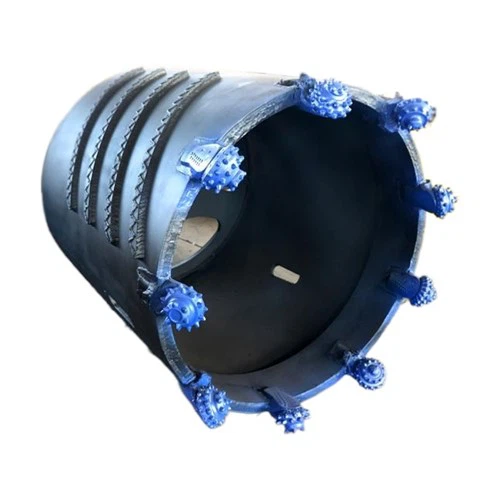
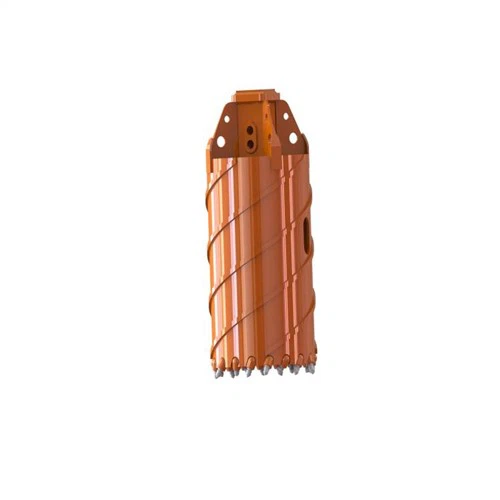
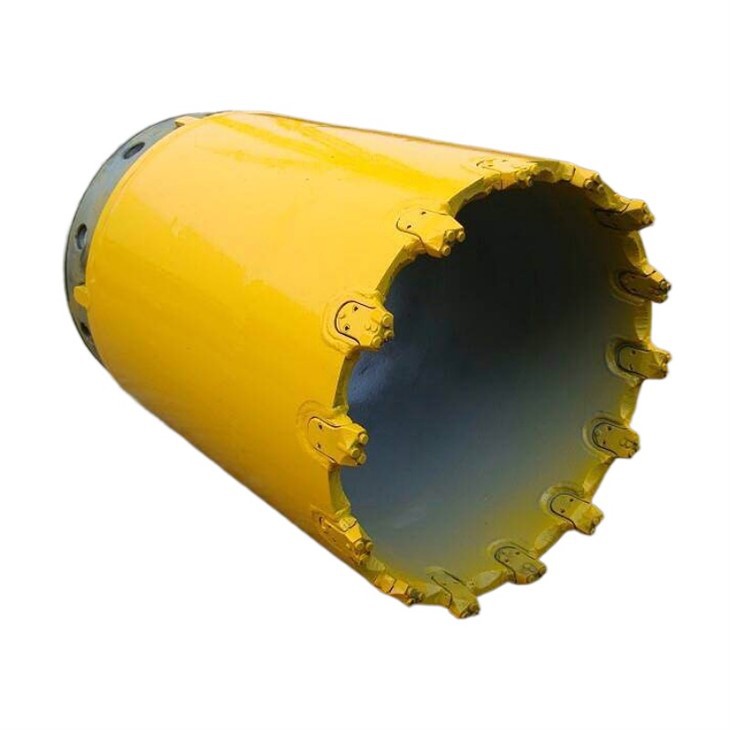
Core barrels are used to bring up rock samples from the drilling operation. The single tube core barrel is the least expensive and most sturdy one with a head section, core recovery tube, a reamer shell, and cutting bit.
Main Products
Mainly manufacture drilling bucket,auger,core barrel,cleaning bucket,casing tube,drilling bits,kelly bar,desander,pile breaker,tremie pipes etc.
Specialized Processing and Equipments
Raw material comes from the biggest supplier of steel plate in China.
4-Rolls CNC rolling machine,max rolling thickness 70mm and width 3200mm,rolling error of one.
Cases
Our products have been sold more than 60 countries and regions:USA,Australia,Canada,New Zealand,Russia,Brazil,Mexico,South East Asia, Bangladesh,Africa etc.
Advanced equipment
We have the most advanced production equipment such as rolling machine, vertical lathe, CNC automatic boring and milling machine.
Core barrels are cutting devices used to collect the core of the drilled rock. The circular device has an open center portion that retains rock core samples from drilling operations. Core barrels are typically used to cut through extremely hard surfaces, such as rock bottomed sea floors and steel reinforced concrete.
Their length varies from 1m to 3m. Core barrels are used when conventional augers are less effective or in conjunction with tapered rock augers for very hard rock drilling. The core barrel is designed with a thin cutting edge to maximize the penetration rate through less contact surface area having to be cut and removed. The main functions of core barrels are to collect sub-surface samples in the shape of core and accompanying sludge material in order to study their mineral assemblage, chemical composition, rock structure, and physical strength for various purposes.
It’s Efficient
First, the drill bit, or core barrel, is efficient with drilling holes. The work is precise, accurate, and produces cleaner boreholes.
Smaller Messes
Using other drilling methods could kick up a lot of dust and debris during the process. Core drilling reduces dust levels, making a smaller mess. This is also great for protecting operators from respiratory distress due to the high levels of dust and debris in the air.
Optimized Safety
Throughout the process of drilling through the concrete of a structure, core drilling creates less risk to optimize safety on a work site. You can also maintain the integrity of the structure you’re drilling.
Less Noise and Disruption
Noise is inevitable on a construction site, but core drilling can keep noise levels to a minimum. For example, a hammer drill creates excess vibrations and noise, disrupting the surrounding homes and businesses. If your work site is near hospitals or schools, consider core drilling because it produces much less noise.


Core Barrels From The Tt Series
Ultra thin wall core barrels are available in 46 and 56 mm diameters, suitable for underground mining. These core barrels need relatively light feed pressure and torque, which means that they use lightweight diamond drills to cut effectively at high rotation speeds.
Core Barrels from the T2 Series
Thin wall core barrels are available in 46, 56, 66, 76, 86 and 101 mm diameters, suitable for general purposes of exploration. These core barrels, especially in harder rock formations, have a relatively small cutting area and therefore allow rapid penetration. Flush water or polymer is needed. Planned for use of metric casing in combination.
Core Barrels from the T6 Series
The T6 series is a continuation of the T2 series, but is more compact in nature and is available with larger diameters of 76, 86, 101, 116, 131 and 146 mm, suitable for general exploration purposes. As the flushing medium, water, mud or air may be used, but oversized bits and head couplings are advised when using air to provide adequate room for the Cuttings for clearing. Planned for use of metric casing in combination. The T6H core barrel is the equivalent of the T6-101 in imperial scale, basically similar in style, but with a slightly smaller O.D. Allowing it to fit inside the HW or HX casing.
Core Barrels from the T6S Series
These core barrels have a split inner tube of aluminium and are intended for use in very loose formations of geotechnical practice. An undisturbed sample is given by the split inner tube combined with face discharge bits. Mud and air flushing is made possible by a large annulus between the inner and outer tubes. The diameters available are 101 and 131mm.
Core Barrels from the WF / WG Series
Geotechnical core barrels, available with N, H, P and S DCDMA diameters. The WF series is built with water or mud as the flushing medium for coring soft formations using face-discharge core parts. Internal discharge core bits are used in the WG series and are built for slightly harder rocks. Compared with metric series T2 and T6, core bits have a relatively wide crown area, and this tends to slow penetration and cause faster bit wear in harder rocks. The head design is very primitive and uses only a single thrust bearing, so that the more advanced core barrels do not rotate as smoothly as the more modern core barrels. They continued to be widely used largely due to clients wishing to specify hole and core sizes according to U.S. and U.K. Standards.
Conventional Triple Tube Core Barrels
In site investigation and core exploratory exploration projects, Triple Tube Core Barrels are intended to optimize core recovery. A split steel tube that fits snugly inside the inner tube (e.g. “Triefus” NMLC and HMLC core barrels) or a transparent plastic tube known as the “Coreliner” or “Triplex” device can be used for triple tube core barrels. To turn several double tube traditional core barrels into triple tube forms, clear, semi-rigid PVC “Coreliners” are available. Prior to any core run, these thin PVC tubes are forced into the inner tunnel. The coreliner (which now includes the drilled core) is extracted easily and in “one piece” after retrieving the core barrel from the hole simply by grasping the lower end of the liner and easing it with a pair of pliers out of the inner tube. Even in difficult formations, this technique can provide 100 per cent core recovery. When using coreliners, special core parts, core lifters and core lifter cases are required with a slightly reduced internal diameter.
Wireline Double Tube Core Barrels “W/L”
In deep holes, wireline core barrels are used, primarily because each time the core is retrieved, they significantly reduce the time spent handling the rod string. An overshot system is dropped on a cable and paired directly onto the inner tube assembly, allowing the core after each core run to be easily retrieved. Accessible in sizes B, N, H from DCDMA. Oh. And P. Also available in S scale is a geotechnical variant of the wireline device (‘GBS’), giving cores in excess of 100 mm.
Wireline Triple Tube Core Barrels “W/L3”
These are typical wireline double tube barrel modifications, but incorporate a third, split tube. After retrieval, the split tube is drained out of the inner tube, allowing the center to be examined in its in-situ state. Generally used in broken, fragmented formations, using face-discharge core bits when high quality core is needed. The use of a third tube allows the bits to cut a core of a slightly smaller diameter than wireline barrels of double tubes. It is possible to use PVC Coreliners instead of the split inner tube, allowing the core to be kept inside the core box in one piece.
Cut The Right Gap
Cut gap on core barrel at proper dimensions, gap-width should not be left too big. Half to 2/3 height of cones should be out of barrel-top after welding. (for special soil formation, need adjust accordingly, contact to know more info.) Steel plates on two sides of the cones should be chamfered.
Even numbers
Roller bit numbers in one core barrel should be even to facilitate the measurement of the diameter. Each pair of opposite roller bits distance shall keep the same. (for big dia, 2500mm above, some special design, the number can differ, contact to get suggested roller bit qty for each core barrel size )
Right angle
The angle of the welding roller bit should be position as 5-6 degrees. This is to protect the vulnerable shirttail place and maximize the cutting surface. (Important notice: different brand roller bit, its journal angle is different, this suggested angle positioned only work on firmtech roller bit. NEW upgraded Firmtech MH-1 & MH-3 no need worry welding angle, check for more info.)
Same flat & circle
Keep all cones at the same height and same round circle, protruding roller bit will be broken easily.
Right distance
The outward and inward roller bit should overlap to the right position ( the most outside point on the outward bit to the most inside point on the inside bit should be 120mm-140mm), otherwise, the inner circle of the roller bit will be worn out quickly.
Cooling down
Put and cool roller cones in water, do not finish welding at a short time but by steps keep the temperature at a low level, especially cool the gap between arm and cone. High temperature may damage the seal O-ring or lubrication system.
Welding By Steps
The roller bit should be welded evenly and slightly to fix the position, then apply the full welding, otherwise, the roller bits and angle will change.
Prepare the Core Barrel and job site
Before actually operating the core drill, it is important to prepare the job site and ensure the drill is ready for use. You will want to:
Check for alignment and possible binding of moving parts, mounting, and any other conditions that may affect core drill operation. Do not use the core drill if it shows any signs of damage.
Read and fully understand the operating manual.
Check the power supply’s flow and pressure output against the core drill’s requirements.
Check for live electrical wiring near the work site or embedded in the material being drilled.
If drilling through a wall, check both sides for possible obstructions.
Before drilling through a floor, provide protection for all personnel and materials below the work area. Cores generally drop from the bit at the completion of the hole.
Ensure all personnel is using the appropriate safety equipment.
Clear the working area of all unauthorized personnel. Place barricades or secure the area so that no person can be injured.
Anchoring a Core Barrel
A core drill can typically be bolt anchored or ceiling jack anchored to the floor or bolt anchored to the wall.
Measure the distance from the center of the anchor bolt slot in the base to the center of the drill spindle.
Mark from the center of the hole on the floor to be drilled to the spot where the anchor bolt hole will be drilled.
Drill and set the anchor bolt. Then place core drill over anchor hole and hand tighten the bolt.
Secure the core drill by tightening the anchor bolt.
Installing a drill bit
Before installing the drill bit, ensure that neither the bit nor the core drill is hot. What’s more, always make sure to wear protective gloves when handling, installing, and removing core drill bits.
Next, remove any dirt or contamination that may have accumulated on either the bit or drill spindle. Once you do that, you can begin to thread the drill bit onto the drill spindle and tighten it securely with a bit wrench.
Operating the Core Barrel
Once you have done the steps above, you are ready to operate the core drill. During this process, you will want to do the following:
Check the hole alignment by lowering the bit with the feed handle until the bit is about 1/2 inch from the concrete. It is important to ensure the bit is not resting on the concrete when starting the core drill.
Make sure to always check the manufacturer’s recommendation for drill speed.
Keep all body parts away from all moving parts of the core drill while in operation.
When geologists give you a specific goal to reach your borehole: Many of them will make specific requirements, a hole going a certain number of meters in a very straight direction. In the absence of drilling deviations, many things will depend on your ability. Most diamond drillers know that it is easier to prevent drilling deviations than to have to correct them once they are off track. One way to avoid the risk of deviation is to stabilize your core barrel before you start drilling, and you do this by changing some of the equipment you usually use.
Outer tube: Your typical core barrel will be equipped with a standard outer tube. A complete hole or hexagonal outer tube is harder than a core barrel. By changing the outer tube to hexagonal or full hole, you will better resist deviations.
Reaming shell: Your next step is to combine this with the expansion reaming shell. If you have more diamond pads on the reaming shell, you will have more control deviation and hole diameter. An 18-inch extended reamer shell will have four diamond rings. The diamond pad on the front will help you stabilize the core barrel and control the direction, while the diamond pad on the back will help maintain the diameter of the hole.
Locking coupling:Choose enhanced diamond locking couplings over standard locking couplings. This type of locking coupling is made of diamond-impregnated ring and water channel similar to a reamed shell. It is the most effective locking coupling to keep the back of the cartridge stable. A cheaper option is a hexagonal locking coupling.
Adapter coupling: Finally, the last part of your new stable core bucket is adapter coupling. Instead of a regular adapter coupling, use a diamond adapter coupling, also called a back reamer. The result of switching your parts for the parts listed above is that you will get the best stable core bucket, which will strongly influence the direction and resist the deviation. However, you should keep in mind that while this device will stabilize the front end of the drill string, it will cause an increase in water pressure in the borehole. This is because the annulus between the hole wall and the core tube is reduced. Circulating water must work harder to get through, so you will notice the stress is rising. Torque inside the hole will also increase, causing more friction.
Hunan SMSCC Heavy Industry Co., Ltd,which was founded in 2013,Focus on R&D, manufacturing and sales of drilling tools for bore piling machine. SMSCC Drill is one of the biggest manufacturers of casing tube and drilling tools in China after more than 10 years development.Meanwhile Hyper Drill is dedicated to providing customers from all over the world with deeper ,greater and stronger foundation engineering products .


Q: What is a Core Barrel?
Q: How does a Core Barrel work?
Q: What are Core Barrels made of?
Q: What is the purpose of using a Core Barrel?
Q: Can Core Barrels be used in any type of ground?
Q: What are the different types of Core Barrels?
Q: What is the typical size of a Core Barrel?
Q: How deep can a Core Barrel drill?
Q: What is the difference between a Core Barrel and a regular drill bit?
Q: How do you choose the right Core Barrel for your application?
Q: Can Core Barrels be used for environmental sampling?
Q: What safety considerations should be taken when using a Core Barrel?
Q: How do you retrieve the core from the Core Barrel?
Q: How do you maintain a Core Barrel?
Q: Are Core Barrels compatible with different drilling rigs?
Q: Can Core Barrels be used for water well drilling?
Q: What is the advantage of using a Core Barrel for geological studies?
Q: How does the design of a Core Barrel affect its efficiency?
Q: What are the limitations of using a Core Barrel?
Q: What accessories are commonly used with Core Barrels?
As one of the leading core barrel manufacturers and suppliers in China, we warmly welcome you to buy durable core barrel for sale here and get free sample from our factory. All customized products are with high quality and competitive price.