

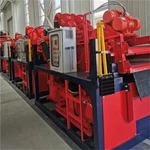

The desander is a crucial device in many industries, especially in the oil and gas, mining, and wastewater treatment sectors. As a leading Slurry Desander supplier, we have been deeply involved in understanding and optimizing the performance of desanders. One of the key factors that significantly influence the separation performance of a desander is the inlet velocity. In this blog, we will explore in detail the effects of the desander's inlet velocity on its separation performance.
The Basics of Desander Operation
Before delving into the impact of inlet velocity, it's essential to understand how a desander works. A desander operates based on the principle of centrifugal force. When a slurry containing solid particles and liquid enters the desander through the inlet, it is forced to rotate within the conical body of the desander. The centrifugal force generated by this rotation causes the heavier solid particles to move towards the outer wall of the desander, while the lighter liquid phase moves towards the center. The separated solid particles are then discharged through the underflow, and the clarified liquid is removed through the overflow.
Influence of Inlet Velocity on Centrifugal Force
The inlet velocity plays a fundamental role in determining the centrifugal force within the desander. According to the formula for centrifugal force (F = m\frac{v^{2}}{r}), where (m) is the mass of the particle, (v) is the tangential velocity, and (r) is the radius of rotation. As the inlet velocity increases, the tangential velocity of the slurry within the desander also increases. This leads to a significant increase in the centrifugal force acting on the solid particles.

A higher centrifugal force enables the desander to separate smaller and lighter particles more effectively. For instance, in a mining operation where the slurry contains fine sand particles, a higher inlet velocity can ensure that these fine particles are subjected to sufficient centrifugal force to be separated from the liquid phase. However, it's important to note that an excessive increase in inlet velocity can also cause problems. If the velocity is too high, the particles may not have enough time to settle properly, leading to an increase in the carry - over of solids in the overflow.
Effect on Particle Separation Efficiency
The separation efficiency of a desander is a measure of how well it can separate solid particles from the liquid phase. In general, an increase in inlet velocity initially leads to an improvement in separation efficiency. This is because, as mentioned earlier, a higher inlet velocity generates a stronger centrifugal force, which helps in separating smaller and more numerous particles.
In laboratory tests, we have observed that when the inlet velocity of a Mud Desander is gradually increased from a relatively low value, the percentage of solid particles removed from the slurry increases. However, after reaching an optimal inlet velocity, any further increase in velocity may result in a decrease in separation efficiency. This is due to the fact that at very high velocities, the turbulent flow within the desander becomes more intense. The turbulence can cause the re - entrainment of separated particles back into the liquid phase, reducing the overall separation efficiency.
Impact on Pressure Drop
The inlet velocity also has a direct impact on the pressure drop across the desander. According to the Bernoulli's principle and the laws of fluid flow, an increase in the inlet velocity of the slurry leads to an increase in the kinetic energy of the fluid. As the fluid passes through the desander, this kinetic energy is converted into pressure energy and potential energy.
A higher inlet velocity generally results in a higher pressure drop across the desander. This is because the faster - moving fluid experiences more resistance as it flows through the conical body of the desander. In practical applications, a high pressure drop can be a concern. It requires more energy to pump the slurry through the desander, which increases the operating cost. Moreover, if the pressure drop is too high, it may cause mechanical stress on the desander components, leading to premature wear and tear.
Influence on Particle Size Distribution in the Overflow and Underflow
The inlet velocity can also affect the particle size distribution in the overflow and underflow of the desander. At a low inlet velocity, larger particles are more likely to be separated and discharged through the underflow, while the overflow may contain a relatively higher proportion of smaller particles.
As the inlet velocity increases, the range of particle sizes that can be separated becomes broader. More smaller particles are also separated and sent to the underflow. However, if the inlet velocity is excessive, some larger particles may be carried over to the overflow due to the high - speed turbulent flow. This can have implications for downstream processes. For example, in an oil and gas drilling operation, if the overflow contains an unacceptable amount of large solid particles, it can cause damage to pumps and other equipment in the fluid - handling system.
Optimal Inlet Velocity for Different Applications
Determining the optimal inlet velocity for a desander depends on several factors, including the characteristics of the slurry (such as particle size distribution, density, and viscosity), the design of the desander (such as the diameter and length of the conical body), and the specific requirements of the application.
In the oil and gas industry, where the desander is used to remove sand and other solid particles from the drilling mud, the optimal inlet velocity typically ranges from 5 to 10 m/s. In mining applications, where the slurry may have a higher solid content and larger particle sizes, the optimal inlet velocity may be slightly higher, around 8 to 12 m/s.
Case Studies
To illustrate the importance of inlet velocity on desander performance, let's consider a few case studies. In an oilfield drilling project, a desander was initially operating at a relatively low inlet velocity. The separation efficiency was poor, and a significant amount of sand was still present in the drilling mud after passing through the desander. By increasing the inlet velocity to the optimal range, the separation efficiency improved significantly, and the amount of sand in the mud was reduced to an acceptable level.

In a mining operation, a desander was experiencing high pressure drops and low separation efficiency. After analyzing the inlet velocity, it was found that the velocity was too high. By adjusting the inlet velocity to a more appropriate value, the pressure drop was reduced, and the separation efficiency increased, leading to cost savings and improved process performance.
Conclusion
In conclusion, the inlet velocity of a desander has a profound impact on its separation performance. It affects the centrifugal force, separation efficiency, pressure drop, and particle size distribution in the overflow and underflow. As a Slurry Desander supplier, we understand the importance of optimizing the inlet velocity to ensure the best performance of our desanders.
If you are looking for a reliable desander solution for your specific application, we invite you to contact us for more information. Our team of experts can help you select the right desander and determine the optimal operating parameters, including the inlet velocity, to meet your separation requirements. Whether you are in the oil and gas, mining, or wastewater treatment industry, we have the expertise and products to provide you with an efficient and cost - effective desanding solution.
References
- Svarovsky, L. (1984). Solid - Liquid Separation. Butterworths.
- Thew, M. T., & Lin, C. J. (1983). Hydrocyclone performance. Chemical Engineering Research and Design, 61(1), 1 - 16.
- Rajamani, R. K., & Brito - Parada, F. (2006). Hydrocyclones: Analysis, Design, and Applications. Society for Mining, Metallurgy, and Exploration.