

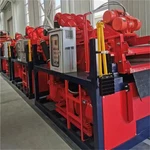

In the realm of water treatment, the quest for efficient desanding solutions is a continuous journey. As a supplier of Mud Desander, I am often asked whether our product can be effectively used for desanding in water treatment processes. This blog post aims to delve into this question, exploring the capabilities of mud desanders in water treatment, their working principles, advantages, limitations, and practical applications.

Understanding Mud Desanders
A Mud Desander is a specialized device designed to separate solid particles, primarily sand and other abrasive materials, from drilling mud or slurry in the oil and gas industry. It operates on the principle of centrifugal force, where the incoming fluid is spun at high speed within a conical chamber. The centrifugal force causes the heavier sand particles to move towards the outer wall of the chamber and be discharged through the bottom outlet, while the cleaner fluid exits through the top outlet.
Can Mud Desanders Be Used in Water Treatment?
The short answer is yes, mud desanders can be used for desanding in water treatment. The basic principle of centrifugal separation employed by mud desanders is applicable to any fluid containing solid particles. In water treatment, the goal is to remove sand, silt, and other suspended solids from the water to improve its quality and prevent damage to downstream equipment. Mud desanders can effectively achieve this by separating the heavier solid particles from the water.
Working Principles in Water Treatment
When used in water treatment, the incoming water is pumped into the mud desander at a high velocity. As the water enters the conical chamber, it begins to spin, creating a centrifugal force. The heavier sand particles are forced towards the outer wall of the chamber and move downwards towards the bottom outlet, while the cleaner water moves towards the center of the chamber and exits through the top outlet. This process effectively removes a significant portion of the sand and other solid particles from the water.

Advantages of Using Mud Desanders in Water Treatment
- High Efficiency: Mud desanders are capable of removing a large percentage of sand and other solid particles from the water in a single pass. This high efficiency reduces the load on downstream filtration systems, improving their performance and lifespan.
- Low Maintenance: Mud desanders have a simple design with few moving parts, making them relatively easy to maintain. Regular inspection and cleaning of the unit can ensure its optimal performance over an extended period.
- Cost-Effective: Compared to other desanding technologies, mud desanders are generally more cost-effective. They require less energy to operate and have a lower initial investment cost, making them an attractive option for water treatment facilities.
- Versatility: Mud desanders can be used in a variety of water treatment applications, including municipal water treatment, industrial water treatment, and groundwater remediation. They can handle a wide range of flow rates and particle sizes, making them suitable for different types of water sources.
Limitations of Mud Desanders in Water Treatment
- Limited Particle Size Range: Mud desanders are most effective at removing particles larger than a certain size. Smaller particles may not be separated efficiently and may require additional filtration steps.
- Sensitivity to Flow Rate and Pressure: The performance of mud desanders is sensitive to the flow rate and pressure of the incoming water. If the flow rate or pressure is too high or too low, the separation efficiency may be affected.
- Need for Pre-Treatment: In some cases, the incoming water may contain large debris or organic matter that can clog the mud desander. Pre-treatment steps, such as screening or sedimentation, may be required to remove these materials before the water enters the desander.
Practical Applications of Mud Desanders in Water Treatment
- Municipal Water Treatment: Mud desanders can be used in municipal water treatment plants to remove sand and other solid particles from the raw water before it enters the treatment process. This helps to protect downstream equipment, such as pumps and filters, and improve the overall quality of the treated water.
- Industrial Water Treatment: In industrial applications, mud desanders can be used to remove sand and other abrasive particles from process water, cooling water, and wastewater. This helps to prevent damage to equipment, reduce maintenance costs, and improve the efficiency of industrial processes.
- Groundwater Remediation: Mud desanders can be used in groundwater remediation projects to remove sand and other solid particles from contaminated groundwater. This helps to improve the quality of the groundwater and reduce the risk of environmental contamination.
Considerations for Using Mud Desanders in Water Treatment
- Proper Sizing: It is important to select a mud desander that is properly sized for the specific water treatment application. The size of the desander will depend on factors such as the flow rate, particle size distribution, and desired separation efficiency.
- Installation and Operation: Mud desanders should be installed and operated according to the manufacturer's instructions. Proper installation and operation can ensure the optimal performance of the desander and prevent damage to the unit.
- Monitoring and Maintenance: Regular monitoring and maintenance of the mud desander are essential to ensure its continued performance. This includes checking the pressure, flow rate, and separation efficiency, as well as cleaning the unit and replacing any worn or damaged parts.
Conclusion
In conclusion, Mud Desander can be effectively used for desanding in water treatment. Their high efficiency, low maintenance, cost-effectiveness, and versatility make them a viable option for a variety of water treatment applications. However, it is important to consider the limitations of mud desanders and take appropriate measures to ensure their optimal performance. If you are interested in using a mud desander for your water treatment needs, please feel free to contact us for more information and to discuss your specific requirements. We are committed to providing high-quality desanding solutions and excellent customer service.
References
- "Centrifugal Separators for Water Treatment." Water Treatment Handbook, edited by Frank R. Spellman, CRC Press, 2016.
- "Desanding Technologies for Water and Wastewater Treatment." Environmental Science and Technology, vol. 49, no. 12, 2015, pp. 7123-7130.
- "The Use of Hydrocyclones in Water Treatment." Journal of Water Supply: Research and Technology - AQUA, vol. 64, no. 3, 2015, pp. 213-222.