

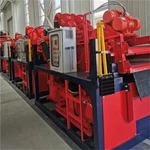

Hey there! As a supplier of Slurry Desanders, I often get asked if these nifty machines can be used in the wastewater treatment industry. Well, let's dive right into it and find out!
First off, what exactly is a Slurry Desander? A Slurry Desander is a device designed to separate solids from liquids in a slurry mixture. It works on the principle of centrifugal force, where the slurry is fed into a cyclone chamber. The spinning action inside the chamber causes the heavier solid particles to be forced to the outer walls and then collected at the bottom, while the cleaner liquid exits from the top. You can learn more about it Slurry Desander.
Now, let's talk about the wastewater treatment industry. Wastewater contains all sorts of stuff - from tiny sand particles to organic matter, chemicals, and even heavy metals. The goal of wastewater treatment is to remove these contaminants and make the water safe to be released back into the environment or reused.
So, can a Slurry Desander play a role in this process? The answer is a big yes! Here's how.
Removing Sand and Grit
One of the primary functions of a Slurry Desander in wastewater treatment is to remove sand and grit. These are common contaminants in wastewater, especially in industrial and municipal settings. Sand and grit can cause a lot of problems in treatment plants. They can wear down pumps, clog pipes, and damage other equipment. By using a Slurry Desander, you can effectively remove these abrasive particles early in the treatment process. This not only protects your equipment but also improves the overall efficiency of the treatment plant.
For example, in a municipal wastewater treatment plant, large amounts of sand and grit enter the system from stormwater runoff and sewage. A Slurry Desander can be installed at the inlet of the plant to separate these particles before they cause any damage. This pre - treatment step can save a lot of money on maintenance and repairs in the long run.
Improving Sedimentation
Another benefit of using a Slurry Desander in wastewater treatment is that it can improve the sedimentation process. After the sand and grit are removed, the remaining wastewater can then be sent to sedimentation tanks. Since the heavier particles have already been separated, the sedimentation process becomes more efficient. The sludge that settles at the bottom of the tanks is more concentrated and easier to handle. This can reduce the volume of sludge that needs to be treated and disposed of, which is a significant cost - saving factor.


Cost - Effectiveness
When it comes to the wastewater treatment industry, cost is always a major concern. Slurry Desanders are relatively inexpensive compared to some other treatment equipment. They have a simple design and require minimal maintenance. Once installed, they can operate continuously with low energy consumption. This makes them a cost - effective solution for both small and large - scale wastewater treatment plants.
Compatibility with Other Treatment Processes
Slurry Desanders can easily be integrated into existing wastewater treatment systems. They can work in conjunction with other treatment processes such as biological treatment, filtration, and disinfection. For example, after the Slurry Desander removes the sand and grit, the wastewater can then be sent to a biological treatment unit to break down organic matter. The cleaner water produced by the Slurry Desander can enhance the performance of these subsequent treatment processes.
However, it's not all sunshine and rainbows. There are a few limitations to using Slurry Desanders in wastewater treatment.
Particle Size Limitation
Slurry Desanders are most effective at removing relatively large particles. They may not be able to remove very fine particles or colloidal matter. For example, some bacteria and viruses in wastewater are too small to be separated by a Slurry Desander. So, additional treatment steps are still required to ensure the water is completely safe.
Variable Wastewater Composition
The composition of wastewater can vary greatly depending on the source. Industrial wastewater may contain high levels of chemicals and heavy metals, while municipal wastewater has a different mix of contaminants. This variability can affect the performance of the Slurry Desander. In some cases, pre - treatment or post - treatment may be needed to optimize the separation process.
Despite these limitations, the benefits of using a Slurry Desander in the wastewater treatment industry far outweigh the drawbacks. They are a valuable tool for improving the efficiency and cost - effectiveness of wastewater treatment plants.
If you're in the wastewater treatment industry and looking for a reliable way to remove sand and grit from your wastewater, a Slurry Desander might be the solution you need. And if you're interested in our Mud Desander or other Slurry Desander products, don't hesitate to reach out. We're here to help you find the right equipment for your specific needs. Whether you have a small - scale treatment plant or a large industrial facility, we can provide you with the best solutions. Contact us today to start a discussion about how our Slurry Desanders can improve your wastewater treatment process.
References
- "Wastewater Treatment: Principles and Design" by Metcalf & Eddy
- "Handbook of Environmental Engineering: Wastewater Treatment" edited by Larry K. Wang