

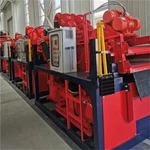

As a desander supplier, I often encounter customers who are confused about the differences between static desanders and dynamic desanders. In this blog post, I will delve into the key disparities between these two types of desanders, their working principles, applications, and advantages, to help you make an informed decision when choosing the right desander for your specific needs.
Working Principles
Static Desander
A static desander, also known as a hydrocyclone desander, operates based on the principle of centrifugal force. The slurry or fluid containing solid particles enters the desander tangentially at a high velocity through the inlet. As the fluid spirals downward inside the conical chamber, the centrifugal force separates the heavier solid particles from the lighter fluid. The solid particles move towards the outer wall of the chamber and are discharged through the underflow outlet at the bottom, while the cleaned fluid exits through the overflow outlet at the top.
The separation efficiency of a static desander depends on several factors, including the size and density of the particles, the flow rate, and the design of the desander. Generally, static desanders are more effective in removing larger particles (typically above 40 microns) and are commonly used in applications where a high flow rate is required.
Dynamic Desander
In contrast, a dynamic desander uses a rotating mechanism to enhance the separation process. The slurry enters the desander and is subjected to both centrifugal and mechanical forces generated by the rotating components. The rotating impeller or blades inside the desander create a strong turbulent flow, which helps to break up agglomerates and improve the separation of fine particles from the fluid.
The dynamic desander can achieve a higher separation efficiency compared to a static desander, especially for finer particles (down to 10 microns or even smaller). The rotating mechanism also allows for better control of the separation process, making it suitable for applications where a high degree of particle removal is required.
Applications
Static Desander
Static desanders are widely used in various industries due to their simplicity, reliability, and cost-effectiveness. Some common applications include:
- Mining and Mineral Processing: In the mining industry, static desanders are used to remove sand and other coarse particles from the slurry before further processing. They are often installed in the primary stages of the processing plant to protect downstream equipment from abrasion and blockage. Mud Desander is a typical type of static desander used in the mining and drilling operations.
- Water Treatment: Static desanders are used in water treatment plants to remove sand, silt, and other suspended solids from the raw water. They can be installed as pre-treatment units before the filtration or sedimentation processes to improve the efficiency of the overall treatment system.
- Oil and Gas Industry: In the oil and gas industry, static desanders are used to remove sand and other solid particles from the produced water or drilling mud. They help to protect the pipelines, pumps, and other equipment from damage and improve the quality of the produced fluids.
Dynamic Desander
Dynamic desanders are typically used in applications where a higher level of particle removal is required. Some common applications include:
- Food and Beverage Industry: In the food and beverage industry, dynamic desanders are used to remove fine particles, such as sand, dirt, and other impurities from the raw materials or finished products. They are often used in the production of fruit juices, beer, and other beverages to ensure product quality and clarity.
- Pharmaceutical Industry: In the pharmaceutical industry, dynamic desanders are used to remove fine particles from the pharmaceutical solutions and suspensions. They are essential for ensuring the purity and quality of the pharmaceutical products.
- Chemical Industry: In the chemical industry, dynamic desanders are used to remove solid particles from the chemical slurries and solutions. They help to improve the quality of the chemical products and prevent damage to the production equipment. Slurry Desander is a type of dynamic desander commonly used in the chemical processing.
Advantages
Static Desander
- Simple Design: Static desanders have a simple and compact design, which makes them easy to install, operate, and maintain. They have no moving parts, which reduces the risk of mechanical failure and downtime.
- High Flow Rate: Static desanders can handle a high flow rate of fluid, making them suitable for large-scale applications. They can be used in parallel to increase the overall flow capacity.
- Cost-Effective: Static desanders are relatively inexpensive compared to dynamic desanders. They have lower initial investment and operating costs, making them a cost-effective solution for many applications.
Dynamic Desander
- High Separation Efficiency: Dynamic desanders can achieve a higher separation efficiency compared to static desanders, especially for fine particles. They can remove a larger percentage of solid particles from the fluid, resulting in a cleaner and higher-quality product.
- Better Control: The rotating mechanism in a dynamic desander allows for better control of the separation process. The speed and intensity of the rotation can be adjusted to optimize the separation efficiency according to the specific requirements of the application.
- Versatility: Dynamic desanders can be used for a wide range of applications, including the removal of fine particles from different types of fluids. They can be customized to meet the specific needs of different industries and processes.
Considerations When Choosing a Desander
When choosing between a static and a dynamic desander, several factors should be considered:


- Particle Size and Concentration: The size and concentration of the particles in the fluid are important factors to consider. If the particles are relatively large (above 40 microns) and the concentration is not too high, a static desander may be sufficient. However, if the particles are fine (below 10 microns) or the concentration is high, a dynamic desander may be required to achieve the desired level of particle removal.
- Flow Rate: The flow rate of the fluid is another important factor. Static desanders are generally more suitable for high flow rate applications, while dynamic desanders can handle lower flow rates with higher separation efficiency.
- Budget: The budget is also an important consideration. Static desanders are generally less expensive than dynamic desanders, both in terms of initial investment and operating costs. However, if the application requires a high level of particle removal, the additional cost of a dynamic desander may be justified.
Conclusion
In conclusion, both static and dynamic desanders have their own advantages and disadvantages, and the choice between them depends on the specific requirements of the application. Static desanders are simple, reliable, and cost-effective, making them suitable for applications where a high flow rate and the removal of larger particles are required. Dynamic desanders, on the other hand, offer a higher separation efficiency, better control, and versatility, making them ideal for applications where a high degree of particle removal is required, especially for finer particles.
As a desander supplier, we can provide you with a wide range of static and dynamic desanders to meet your specific needs. Our experienced team can help you select the right desander for your application and provide you with professional installation, maintenance, and after-sales service. If you are interested in our desander products or have any questions, please feel free to contact us for further discussion and negotiation. We look forward to working with you to find the best desander solution for your business.
References
- Perry, R. H., & Green, D. W. (2008). Perry's Chemical Engineers' Handbook. McGraw-Hill.
- Svarovsky, L. (2000). Solid-Liquid Separation. Butterworth-Heinemann.