



What is the impact of the diameter change of a tremie pipe on the flow?
As a tremie pipe supplier, I've witnessed firsthand the critical role these pipes play in various construction and industrial applications, especially in underwater concrete pouring. One of the most frequently asked questions from our clients is about the impact of the diameter change of a tremie pipe on the flow. In this blog post, I'll delve into this topic, exploring the scientific principles and practical implications of altering the pipe diameter.
Understanding the Basics of Flow in Tremie Pipes
Before we discuss the impact of diameter changes, let's briefly review the basic principles of fluid flow in tremie pipes. A tremie pipe is a long, vertical pipe used to place concrete underwater. The concrete is poured into the top of the pipe and flows downward under the force of gravity. The flow rate and behavior of the concrete are influenced by several factors, including the diameter of the pipe, the viscosity of the concrete, and the height of the concrete column in the pipe.
The flow of concrete in a tremie pipe can be described using the principles of fluid mechanics. According to the Hagen - Poiseuille's law for laminar flow in a cylindrical pipe, the volumetric flow rate (Q) is given by the formula:
[Q=\frac{\pi R^{4}\Delta P}{8\mu L}]
where (R) is the radius of the pipe, (\Delta P) is the pressure difference across the ends of the pipe, (\mu) is the dynamic viscosity of the fluid, and (L) is the length of the pipe. From this formula, we can see that the flow rate is proportional to the fourth power of the radius of the pipe. This means that a small change in the diameter (and thus the radius) of the pipe can have a significant impact on the flow rate.
Impact of Increasing the Diameter
When the diameter of a tremie pipe is increased, several positive effects can be observed in the flow of concrete.
Higher Flow Rate
As mentioned earlier, the flow rate is proportional to the fourth power of the radius. So, if the diameter is doubled, the radius is also doubled, and the flow rate will increase by a factor of (2^{4}=16). This means that a larger - diameter tremie pipe can deliver concrete at a much faster rate. In large - scale construction projects where a large volume of concrete needs to be placed quickly, this can significantly reduce the construction time. For example, in the construction of a large bridge pier underwater, a larger - diameter tremie pipe can ensure that the concrete is placed in a timely manner, reducing the risk of cold joints in the concrete structure.
Reduced Resistance
A larger - diameter pipe offers less resistance to the flow of concrete. The frictional forces between the concrete and the inner wall of the pipe are lower, which allows the concrete to flow more smoothly. This is particularly important when using high - viscosity concrete or when the pipe is long. With reduced resistance, the concrete is less likely to get stuck in the pipe, minimizing the chances of blockages. Our Threaded Tremie Pipe with larger diameters is designed to provide a smooth and efficient flow path for concrete.
Improved Concrete Quality
The smoother flow in a larger - diameter pipe can also lead to better - quality concrete placement. When the concrete flows freely, it is less likely to segregate. Segregation occurs when the components of the concrete (such as aggregates, cement, and water) separate from each other, which can weaken the final concrete structure. By ensuring a more uniform flow, a larger - diameter tremie pipe helps to maintain the integrity of the concrete mix.
Impact of Decreasing the Diameter
On the other hand, decreasing the diameter of a tremie pipe also has its own set of implications.
Lower Flow Rate
A smaller - diameter pipe results in a lower flow rate. This can be a disadvantage in projects where a large volume of concrete needs to be placed quickly. However, in some cases, a lower flow rate may be desirable. For example, in small - scale underwater repairs or in situations where precise placement of concrete is required, a slower flow rate can give the construction team more control over the placement process.
Higher Resistance
The frictional forces between the concrete and the inner wall of the pipe are higher in a smaller - diameter pipe. This can lead to increased energy requirements to pump the concrete through the pipe. In extreme cases, the high resistance can cause blockages, especially if the concrete has a high viscosity or if there are large aggregates in the mix. To mitigate this issue, our Wire Cable Tremie Pipe with smaller diameters is designed with a smooth inner surface to reduce friction.
Potential for Segregation
The restricted flow in a smaller - diameter pipe can increase the likelihood of segregation. As the concrete struggles to flow through the narrow passage, the aggregates may settle out, leading to a non - uniform concrete mix. This can compromise the strength and durability of the final concrete structure.
Practical Considerations in Choosing the Diameter
When choosing the diameter of a tremie pipe, several practical factors need to be considered.
Project Scale
For large - scale projects such as the construction of dams or large bridges, larger - diameter pipes are generally preferred due to the need for a high flow rate. In contrast, small - scale projects like underwater foundation repairs may require smaller - diameter pipes for more precise placement.

Concrete Properties
The viscosity and aggregate size of the concrete also play a crucial role. High - viscosity concrete or concrete with large aggregates may require a larger - diameter pipe to ensure smooth flow. Our technical team can provide guidance on the appropriate pipe diameter based on the specific concrete mix design.
Equipment Compatibility
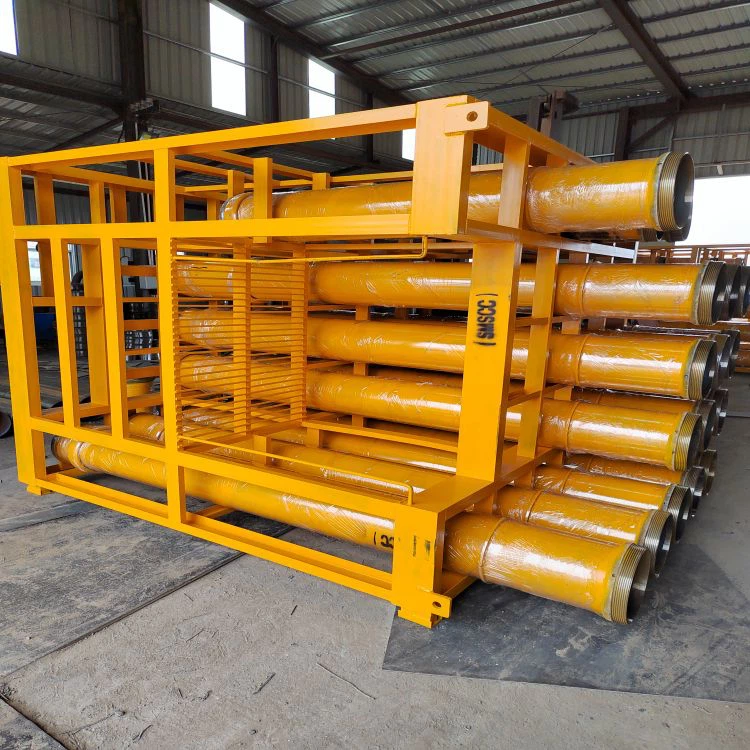
The diameter of the tremie pipe should be compatible with the concrete pumping equipment. The pump needs to be able to generate enough pressure to push the concrete through the pipe. In addition, the handling equipment, such as the Tremie Rack, should be able to support the pipe safely.
Conclusion
The diameter of a tremie pipe has a profound impact on the flow of concrete. A larger diameter leads to a higher flow rate, reduced resistance, and improved concrete quality, while a smaller diameter offers more control over the placement process but may have issues with flow rate and segregation. As a tremie pipe supplier, we understand the importance of choosing the right diameter for each project. Our team of experts is always ready to assist you in selecting the most suitable tremie pipe for your specific needs.
If you are interested in purchasing tremie pipes or have any questions about pipe diameter selection, please feel free to contact us for a detailed discussion. We look forward to working with you on your next project.
References
- White, F. M. (2006). Fluid Mechanics. McGraw - Hill.
- ACI Committee 304. (2016). Guide for Measuring, Mixing, Transporting, and Placing Concrete. American Concrete Institute.