

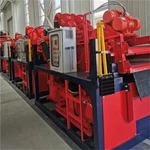

Hey there! As a supplier of Mud Desanders, I've seen firsthand how crucial it is to understand the ins and outs of these machines. One topic that often comes up in discussions with customers is the impact of pressure pulsation on the performance of a Mud Desander. So, let's dive right in and explore this issue.
First off, what exactly is pressure pulsation? Well, it's basically the fluctuation in pressure that occurs within a fluid system. In the context of a Mud Desander, this can happen due to a variety of reasons. For example, the operation of pumps can cause pressure spikes and dips as they start, stop, or change their flow rate. Also, the movement of solids within the mud can create uneven pressure distribution.
Now, how does this pressure pulsation affect the performance of a Mud Desander?
1. Separation Efficiency
The primary job of a Mud Desander is to separate solid particles from the mud. Pressure pulsation can mess with this process big time. When the pressure fluctuates, it can disrupt the normal flow patterns inside the desander. The solid particles that are supposed to be separated and sent to the underflow might not follow the expected path. Instead, they could end up being carried back into the overflow, reducing the overall separation efficiency.
Let's say you're using a Mud Desander in an oil drilling operation. If the separation efficiency drops, it means more solid particles will remain in the mud. This can lead to increased wear and tear on downstream equipment, such as pumps and drill bits. It can also affect the quality of the drilling fluid, which in turn can impact the drilling process itself.
2. Structural Integrity
Another significant impact of pressure pulsation is on the structural integrity of the Mud Desander. The constant changes in pressure can put stress on the walls of the desander. Over time, this can cause fatigue and lead to cracks or other forms of damage.
Think of it like bending a paperclip back and forth. The more you do it, the more likely it is to break. Similarly, the repeated pressure pulsation can weaken the structure of the desander. This is especially true if the desander is made of materials that are not very resistant to fatigue. If the desander fails structurally, it can result in costly downtime for repairs and replacement.
3. Flow Stability
Pressure pulsation can also disrupt the flow stability within the Mud Desander. A stable flow is essential for proper separation to occur. When the pressure fluctuates, it can create turbulence and eddies in the fluid. These irregular flow patterns make it difficult for the solid particles to settle and be separated effectively.
Moreover, unstable flow can cause the desander to operate in an inconsistent manner. The amount of solids removed and the quality of the separated mud can vary from one moment to the next. This lack of predictability can be a real headache for operators who rely on consistent performance from their equipment.


4. Noise and Vibration
Excessive pressure pulsation often leads to increased noise and vibration in the Mud Desander. This not only creates an unpleasant working environment but can also be a sign of underlying problems. The noise and vibration can be caused by the sudden changes in pressure causing the desander to shake or rattle.
In addition to being a nuisance, the vibration can further damage the desander and its components. It can loosen bolts and connections, leading to potential leaks or malfunctions. And if the vibration is severe enough, it can even affect the surrounding equipment and infrastructure.
So, what can be done to mitigate the impact of pressure pulsation on a Mud Desander?
One approach is to use proper pulsation dampeners. These devices are designed to absorb and reduce the pressure fluctuations, providing a more stable pressure environment for the desander. Another important factor is to ensure that the pumps and other equipment in the system are properly sized and operated. Incorrect pump settings can be a major cause of pressure pulsation, so getting these right is crucial.
Regular maintenance and inspection of the Mud Desander are also essential. By checking for signs of wear, damage, or fatigue, you can catch potential problems early and take corrective action before they become serious.
As a supplier, I understand the importance of providing high - quality Mud Desanders that can withstand the challenges of pressure pulsation. Our Mud Desanders are designed with the latest technology and high - quality materials to minimize the impact of pressure fluctuations. We also offer a range of support services to help our customers optimize the performance of their desanders.
If you're in the market for a reliable and efficient Mud Desander, or if you're experiencing issues with pressure pulsation in your existing system, don't hesitate to reach out. We're here to help you find the best solution for your needs. Whether you're involved in oil and gas drilling, mining, or any other industry that requires solid - liquid separation, our team of experts can provide you with the guidance and support you need.
In addition to Mud Desanders, we also offer Slurry Desanders that are suitable for different applications. These desanders are designed to handle a variety of slurries and can also be affected by pressure pulsation. But with our products, you can be confident that you're getting a high - performance solution that can stand up to the challenges.
So, if you're interested in learning more about our products or discussing your specific requirements, feel free to contact us. We're always happy to have a chat and see how we can help you improve your operations.
References
- Smith, J. (2018). "Fluid Dynamics in Solid - Liquid Separation Equipment". Journal of Industrial Fluid Mechanics.
- Brown, A. (2019). "The Effects of Pressure Pulsation on Industrial Equipment". Engineering Research Quarterly.
- Green, C. (2020). "Optimizing the Performance of Desanders in Drilling Operations". Oil and Gas Technology Review.