

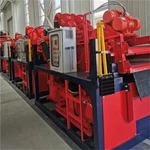

As a desander supplier, I often get asked about the maximum particle size that a desander can handle. It's a crucial question, especially for industries like oil and gas, mining, and construction, where efficient separation of solids from liquids is a must. In this blog, I'll break down the factors that determine this maximum particle size and give you a clearer picture of what to expect from our desanders.
First off, let's understand what a desander is. A desander is a piece of equipment designed to remove sand and other solid particles from a liquid stream. There are different types of desanders out there, like the Mud Desander and the Slurry Desander, each tailored to specific applications.
The maximum particle size a desander can handle depends on several factors. One of the main ones is the design of the desander itself. The internal geometry, including the diameter of the cyclone, the length of the cone, and the size of the inlet and outlet ports, plays a huge role. A larger cyclone diameter generally allows for the handling of larger particles. This is because the centrifugal force acting on the particles is related to the size of the cyclone. In a bigger cyclone, the particles have more space to move and separate from the liquid.
Another important factor is the flow rate of the liquid through the desander. If the flow rate is too high, the particles may not have enough time to separate properly. On the other hand, if the flow rate is too low, the efficiency of the desander may decrease. The ideal flow rate depends on the size and design of the desander, as well as the properties of the liquid and the particles.
The density and shape of the particles also matter. Heavier particles are easier to separate than lighter ones because they are more affected by the centrifugal force. Irregularly shaped particles may have a harder time moving through the desander compared to spherical particles. This is because the shape can affect how the particles interact with the liquid and the walls of the cyclone.
Let's talk about the typical maximum particle sizes for different types of desanders. In general, our standard desanders can handle particles up to about 100 to 150 microns in size. However, for larger industrial applications, we can customize desanders to handle particles up to 500 microns or even larger. These custom - designed desanders are built with larger cyclones and optimized internal geometries to ensure efficient separation of the larger particles.
For the Mud Desander, which is commonly used in the oil and gas industry to remove sand from drilling mud, the maximum particle size is usually in the range of 74 to 150 microns. This is because the drilling mud has specific properties, and the desander needs to be designed to work effectively within those parameters. The desander helps to keep the mud clean, which is essential for the smooth operation of the drilling equipment.
The Slurry Desander, on the other hand, is often used in mining and construction applications. These desanders can typically handle particles in the range of 100 to 200 microns, but again, custom designs can handle much larger particles. In mining, for example, the slurry may contain large amounts of sand and other solids that need to be separated before further processing.
It's important to note that while a desander can handle particles up to a certain size, the efficiency of separation may vary. For particles close to the maximum size, the separation efficiency may not be as high as for smaller particles. This is because the larger particles may be more difficult to separate completely from the liquid. However, our desanders are designed to provide the best possible separation efficiency even for larger particles.
We use advanced engineering techniques and high - quality materials in the manufacturing of our desanders. The cyclones are made from wear - resistant materials to ensure a long service life, especially when dealing with abrasive particles. We also conduct rigorous testing on our desanders to ensure that they meet the specified performance criteria.
If you're in an industry that requires the separation of solids from liquids and you're not sure if our desanders can handle your specific particle size requirements, don't hesitate to reach out. We have a team of experts who can analyze your needs and recommend the best desander solution for you. Whether you need a standard desander or a custom - designed one, we've got you covered.


In conclusion, the maximum particle size that a desander can handle depends on multiple factors such as design, flow rate, particle density, and shape. Our desanders, including the Mud Desander and the Slurry Desander, are capable of handling a wide range of particle sizes, and we can customize them to meet your specific requirements. If you're interested in learning more about our desanders or want to discuss a potential purchase, get in touch with us. We're here to help you find the most efficient and cost - effective solution for your solid - liquid separation needs.
References
- Perry, R. H., & Green, D. W. (2008). Perry's Chemical Engineers' Handbook. McGraw - Hill.
- Svarovsky, L. (1984). Solid - Liquid Separation. Butterworths.