

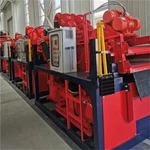

Hey there! As a supplier of Mud Desanders, I often get asked about how these nifty machines work. So, I thought I'd take a few minutes to break down the working principle of a Mud Desander for you.
First off, let's talk about what a Mud Desander is and why it's important. A Mud Desander, you can check out more details Mud Desander, is a key piece of equipment in the oil and gas drilling industry, as well as in other industries where you need to separate solids from a liquid slurry. The main goal is to remove larger solid particles from the drilling mud, which helps to keep the mud in good condition and protects downstream equipment.
The Basics of the Separation Process
The working principle of a Mud Desander is based on the concept of hydrocyclone separation. Hydrocyclones are simple yet highly effective devices that use centrifugal force to separate particles of different sizes and densities from a liquid mixture.
When the drilling mud, which is a slurry of water, clay, and various additives along with solid particles from the drilling process, enters the Mud Desander, it's fed into the hydrocyclone under pressure. The hydrocyclone is a conical-shaped chamber where the magic happens.
How the Hydrocyclone Works
As the mud enters the hydrocyclone through a tangential inlet, it starts to spin rapidly inside the chamber. This spinning motion creates a strong centrifugal force. The centrifugal force is what does the heavy lifting in separating the solid particles from the liquid.
The larger and heavier solid particles in the mud are pushed towards the outer wall of the hydrocyclone by the centrifugal force. As they move along the outer wall, they gradually spiral down towards the bottom of the hydrocyclone, which is called the underflow or the “sand discharge”. These particles are then removed from the system, effectively getting rid of the larger contaminants in the mud.
On the other hand, the lighter liquid and smaller particles are forced towards the center of the hydrocyclone. They form a column of fluid that moves upwards towards the top of the hydrocyclone, which is called the overflow. The overflow is essentially the “cleaned” mud that can be recirculated back into the drilling process.
Key Components of a Mud Desander
A typical Mud Desander consists of several important components that work together to make the separation process happen.
- Inlet Pipe: This is where the drilling mud enters the Mud Desander. It's designed to direct the mud into the hydrocyclone in a way that creates the necessary spinning motion.
- Hydrocyclone Body: The conical-shaped body of the hydrocyclone is the heart of the system. It's where the centrifugal separation takes place. The design of the hydrocyclone, including its diameter, length, and cone angle, can have a big impact on its performance.
- Underflow Nozzle: This is the opening at the bottom of the hydrocyclone where the separated solid particles are discharged. The size of the underflow nozzle needs to be carefully adjusted to ensure that the right amount of solids is removed without losing too much of the valuable drilling mud.
- Overflow Pipe: The overflow pipe is located at the top of the hydrocyclone and is used to collect the cleaned mud. It's connected to the downstream equipment where the mud will be further processed or reused.
Factors Affecting the Performance of a Mud Desander
There are several factors that can affect how well a Mud Desander works.
- Inlet Pressure: The pressure at which the mud enters the hydrocyclone is crucial. If the pressure is too low, the centrifugal force may not be strong enough to separate the particles effectively. On the other hand, if the pressure is too high, it can cause excessive wear on the hydrocyclone and may also lead to the discharge of too much liquid along with the solids.
- Particle Size and Density: The size and density of the solid particles in the mud play a big role in the separation process. Larger and denser particles are easier to separate than smaller and lighter ones. If the mud contains a lot of very fine particles, the Mud Desander may not be able to remove them all, and additional separation steps may be required.
- Flow Rate: The flow rate of the mud through the Mud Desander also affects its performance. If the flow rate is too high, the mud may not have enough time to be properly separated in the hydrocyclone. If the flow rate is too low, it can lead to inefficient operation and may cause the hydrocyclone to clog.
Comparison with Slurry Desanders
You might also be familiar with Slurry Desander. While both Mud Desanders and Slurry Desanders use hydrocyclone technology for separation, there are some differences. Slurry Desanders are generally used in a wider range of industries, such as mining and construction, where the slurry may have a different composition and particle size distribution compared to drilling mud. However, the basic working principle remains the same - using centrifugal force to separate solids from liquid.
Why Choose Our Mud Desanders
As a supplier of Mud Desanders, we've put a lot of effort into designing and manufacturing high-quality products. Our Mud Desanders are made from durable materials that can withstand the harsh conditions of the drilling environment. They're also designed to be easy to operate and maintain, which can save you time and money in the long run.
We offer a range of Mud Desanders with different capacities and specifications to meet the needs of different drilling operations. Whether you're working on a small-scale project or a large offshore drilling rig, we've got a solution for you.
Contact Us for Your Mud Desander Needs
If you're in the market for a Mud Desander, or if you have any questions about how our products work, don't hesitate to reach out. We're here to help you find the right solution for your specific requirements. Whether you need a single Mud Desander or a complete solids control system, we can provide you with the expertise and support you need.


In conclusion, the working principle of a Mud Desander is based on the simple yet effective concept of hydrocyclone separation. By using centrifugal force, these machines can efficiently remove larger solid particles from drilling mud, helping to keep your drilling operations running smoothly. If you're looking for a reliable Mud Desander supplier, give us a chance to show you what we can do.
References
- “Hydrocyclone Technology: Principles and Applications” - A comprehensive guide on hydrocyclone technology and its use in various industries.
- “Drilling Mud Solids Control Handbook” - A valuable resource for understanding the importance of solids control in the drilling industry and the role of Mud Desanders.