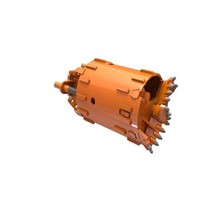


The Bore Pile Rock Drilling Bucket is a precision-engineered solution for all your bore pile rock drilling needs. Crafted with the latest technology and top-quality materials, it ensures efficient and accurate drilling operations.
This drilling bucket is designed to handle the toughest rock formations, making the process of creating bore piles a seamless and hassle-free experience. Its robust construction and innovative design allow for enhanced durability and performance, reducing downtime and increasing productivity on the job site.
Precision drilling is a technique that enables the creation of holes with high accuracy and precision. The apparatus is capable of drilling holes in rock strata with a precise diameter and verticality, thus ensuring that the design requirements are met and that the quality and bearing capacity of the grouted piles are guaranteed.To illustrate, the diameter of the pile hole can be precisely calibrated to ensure the dimensional accuracy of the grouted piles.
Efficient Rock Breaking: The optimized design for rock characteristics enables rapid and effective fragmentation of hard rocks, enhancing drilling efficiency and reducing construction time. In instances where high-strength rocks are encountered, the drilling operation can be completed at a faster rate than with conventional drilling tools.
Features:
Bore Pile Rock Drilling Bucket
Cylindrical barrel or Conical barrel(optional).
Throughout ventilation hole.
Hard facing strips for wear protection.
Double cut or Single cut(optional)
Kelly box 130mm,150mm,200mm,250mm (optional).
Bore Pile Rock Drilling Bucket Index
| Drilling Diameter | Shell Length | Shell Dia. | Shell Thickness | Upper Plate Thinkess | Bottom Plate Thinkcess | Teeth No. |
| mm | mm | mm | mm | mm | mm | nos |
| Φ600 | 1200 | 550 | 16 | 40 | 50 | 6 |
| Φ700 | 1200 | 600 | 20 | 40 | 50 | 8 |
| Φ800 | 1200 | 700 | 20 | 40 | 50 | 9 |
| Φ900 | 1200 | 800 | 20 | 40 | 50 | 11 |
| Φ1000 | 1200 | 900 | 20 | 40 | 50 | 13 |
| Φ1100 | 1200 | 1000 | 20 | 40 | 50 | 15 |
| Φ1200 | 1200 | 1100 | 20 | 40 | 50 | 16 |
| Φ1300 | 1200 | 1200 | 20 | 40 | 50 | 18 |
| Φ1400 | 1200 | 1300 | 20 | 40 | 50 | 18 |
| Φ1500 | 1200 | 1400 | 20 | 40 | 50 | 20 |
| Φ1600 | 1200 | 1500 | 20 | 40 | 50 | 22 |
| Φ1700 | 1000 | 1600 | 20 | 40 | 50 | 24 |
| Φ1800 | 1000 | 1700 | 20 | 40 | 50 | 26 |
| Φ1900 | 1000 | 1800 | 20 | 40 | 50 | 26 |
| Φ2000 | 800 | 1900 | 20 | 40 | 50 | 30 |
| Φ2100 | 800 | 2000 | 20 | 40 | 50 | 30 |
| Φ2200 | 800 | 2100 | 20 | 40 | 50 | 31 |
| Φ2300 | 800 | 2200 | 20 | 40 | 50 | 32 |
| Φ2400 | 800 | 2300 | 20 | 40 | 50 | 34 |
| Φ2500 | 800 | 2400 | 20 | 40 | 50 | 34 |
| ※Other size can be customized as per customer demand | ||||||
Two common types for bored piles piling foundation construction
In the realm of bored pile foundation construction using rotary drilling equipment, various types of buckets are utilized. We highlight two of the most frequently employed varieties: the Rock Drilling Bucket and the Soil Drilling Bucket.
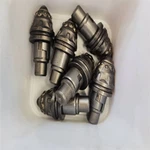
The Rock Drilling Bucket, equipped with bullet teeth, is extensively applied for drilling through challenging hard strata such as sand and gravel layers, pebble beds, flagstone, high-strength frozen soil, and weathered rock in bored pile projects.
Conversely, the Soil Drilling Bucket with flat teeth, like the 18T and 25T models, is ideal for water-saturated cohesive and non-cohesive soils, including clay, silt, and loose to medium dense sand and gravel, as well as coarse gravel.
Customizable Items
1.Cutting DIA. Custom : design various cutting diameter based on demand, like φ750,φ1550 etc.
2.Shell HIT. Custom : design as demand, prolong or shortten, increase of efficiency by drilling more.
3.Key Component Reinforce Custom : strengthen the key component to extend life cycle;
4.Cutter Custom: single cutter and double cutter design as demand;
5.Bottom Custom : single bottom and double bottom design as demand;
6.Kelly Box Custom : custom kelly box size based on the kelly bar, like 150*150,200*200 etc;
7.Bottom Open Mechanic : half-automatic or manul mechanic bottom open system.
When to use bored piles?
Bored piles, also known as drilled shafts, are a type of deep foundation used in construction when the following conditions are present:
Weak Soil Conditions: When the surface soil is weak and cannot support the structural loads, bored piles are used to transfer the load to deeper, more stable soil or rock layers.
Limited Space: In urban areas or on sites with limited space, bored piles can be used because they cause less disturbance to adjacent structures and can be installed in tight spaces.
High Load Requirements: For structures that require high load-bearing capacity, such as high-rise buildings, bridges, and heavy industrial facilities, bored piles can be designed to carry substantial loads.
Rocky or Variable Soil Profiles: In areas with rocky soil or where the soil profile varies significantly, bored piles can be custom-designed to accommodate the varying conditions.
Noise and Vibration Sensitivity: In environments where noise and vibration must be minimized, bored piles can be a preferable choice because they are less disruptive than other types of foundation construction.
Water Table Issues: When the water table is high or when there are concerns about groundwater, bored piles can be installed using casing or slurry techniques to prevent water inflow and soil collapse.
Economic Considerations: In some cases, bored piles may be more cost-effective than other foundation types, especially when dealing with difficult soil conditions or when the construction schedule requires rapid installation.
Environmental Constraints: In environmentally sensitive areas, bored piles can be installed with minimal impact on the surrounding ecosystem.
Foundation Rehabilitation: Bored piles can be used to underpin existing structures that are experiencing settlement or to increase the load-bearing capacity of existing foundations.
Precision Requirements: When precise placement of the foundation is necessary, bored piles can be accurately positioned, which is crucial for certain types of structures or when working around existing utilities.
In summary, bored piles are typically used when the project requires a deep foundation that can handle heavy loads, when the soil conditions are variable or poor, and when there are space constraints or environmental considerations that make other types of foundations less suitable.
How deep are bored piles?
The depth of bored piles, also known as drilled shafts, can vary widely depending on the project requirements, soil conditions, and the design of the foundation. Here are some general guidelines on the potential depths of bored piles:
Shallow Bored Piles: These can range from a few meters up to about 20 meters in depth. They are often used for smaller structures or in areas where the soil conditions are relatively stable closer to the surface.
Medium-Depth Bored Piles: These typically range from 20 to 50 meters in depth. They are common in urban construction where there may be a need to bypass upper layers of soil and reach more stable strata.
Deep Bored Piles: Depths can extend from 50 to over 100 meters. Deep piles are often used in high-rise buildings, major bridge projects, and in areas where very deep soil or rock strata must be reached to ensure stability.
Ultra-Deep Bored Piles: In some specialized cases, such as for certain offshore structures or in challenging geological conditions, bored piles can be drilled to depths exceeding 100 meters, sometimes reaching several hundred meters deep.
The actual depth of a bored pile is determined by several factors, including:
Load Requirements: The structural loads that the pile needs to support will influence the depth and design of the pile.
Soil Conditions: The type of soil and the depth at which stable soil or rock is encountered will affect the pile depth.
Project Design: The design of the structure and the foundation requirements will dictate the depth of the piles.
Environmental Considerations: In environmentally sensitive areas, deeper piles may be used to minimize surface disturbance.
Economic Factors: The cost of drilling deeper piles can be significant, so economic considerations will also play a role in determining pile depth.
In practice, the depth of bored piles is determined through a combination of geotechnical investigation, structural engineering design, and project-specific requirements.
Advantages
1. We possess the latest and most advanced production equipment for casing tubes and drilling implements, ensuring high precision and quality.
2. We are a one-stop manufacturer of diverse drilling tools like drilling buckets, augers, core barrels, and more, meeting all your drilling needs.
3. We have shortened the delivery time and partnered with top material suppliers to offer prompt service and quality products.
4. Our prices are more competitive than most suppliers, thanks to efficient cost management and strategic sourcing.
5. Direct factory sales with competitive price.
Cases


Workshop

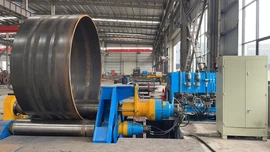

Details


Packing and Delivery


FAQ
Q: What's the maximum diameter of drilling bucket can you make?
Q:Do you have single cut clay drilling bucket?
Q: What drilling bits do you have for the bullet teeth drilling bucket?
Hot Tags: bore pile rock drilling bucket, China bore pile rock drilling bucket manufacturers, suppliers, factory, drilling bucket without teeth, drilling bucket for rock drilling, drilling bucket for oil drilling, Bullet Teeth Rock Drilling Bucket, drilling bucket for borehole drilling, Bore Pile Rock Drilling Bucket