

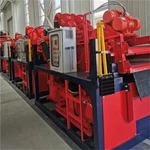

Pile breakers are essential tools in the construction industry, designed to efficiently remove the excess length of concrete piles after they have been driven or cast in place. As a supplier of pile breakers, I have witnessed firsthand the remarkable capabilities of these machines. However, like any piece of equipment, pile breakers have their limitations. Understanding these limitations is crucial for construction professionals to make informed decisions about their use and to ensure optimal performance on the job site.
1. Geotechnical Limitations
One of the primary limitations of pile breakers is their performance in different soil and rock conditions. Pile breakers are most effective in relatively homogeneous and soft to medium - hard soil conditions. In extremely hard rock or highly variable soil profiles, the efficiency of pile breakers can be significantly reduced.
When dealing with hard rock, the impact force required to break the pile may exceed the capacity of the pile breaker. The chisels or breaking heads of the pile breaker may wear out quickly, leading to increased maintenance costs and downtime. For example, in a project where piles are driven into granite - rich soil, the pile breaker may struggle to make clean breaks, and the process may become time - consuming.
In highly variable soil profiles, such as those with alternating layers of soft clay and hard sandstone, the pile breaker may face difficulties in maintaining a consistent breaking force. The sudden change in soil resistance can cause uneven stress distribution on the pile, which may lead to incomplete breaks or damage to the pile breaker itself.
2. Pile Geometry and Size Limitations
Pile breakers are designed to work with specific pile geometries and sizes. Most standard pile breakers are suitable for circular or square piles within a certain diameter or side - length range. For non - standard pile shapes, such as hexagonal or octagonal piles, it can be challenging to find a pile breaker that can provide an effective and uniform break.
In terms of size, very large - diameter piles can pose a problem. While there are 1000mm Foundation Pile Breaker available in the market, as the pile diameter increases beyond the capacity of the pile breaker, the breaking process becomes more complex. The force required to break a larger pile is proportionally higher, and the pile breaker may not be able to generate sufficient force to achieve a clean break. This can result in partial breaks, where the pile remains partially intact, requiring additional manual or mechanical intervention.
On the other hand, very small - diameter piles also present limitations. The breaking heads of pile breakers are designed to fit a certain minimum size, and if the pile diameter is too small, the pile breaker may not be able to grip the pile properly, leading to inefficient breaking or potential damage to the pile.
3. Access and Space Limitations
Construction sites often have limited access and space, which can restrict the use of pile breakers. Pile breakers, especially larger models, require a certain amount of clearance around the pile to operate effectively. In congested areas, such as urban construction sites with limited space between buildings or in underground construction projects, it may be difficult to maneuver the pile breaker into the correct position.
For example, in a basement construction project where piles are closely spaced, the pile breaker may not be able to access all the piles without colliding with adjacent structures or other piles. This can lead to a situation where some piles cannot be broken using the pile breaker, and alternative methods, such as manual breaking, may need to be employed.
In addition, the height of the pile above the ground can also be a limiting factor. If the pile is too short or too long, it may be difficult for the pile breaker to engage with the pile properly. A very short pile may not provide enough surface area for the pile breaker to grip, while a very long pile may require the pile breaker to be lifted to a significant height, which can be challenging and dangerous on a construction site.
4. Noise and Vibration Limitations
Pile breakers generate significant noise and vibration during operation. In urban or residential areas, the noise and vibration can cause disturbances to nearby residents and may even violate local environmental regulations. The high - impact forces used by pile breakers to break the piles result in loud noise levels, which can be a nuisance to the surrounding community.


The vibration generated by pile breakers can also have a negative impact on nearby structures. In areas where there are old or sensitive buildings, the vibration can cause structural damage, such as cracking in walls or foundations. This requires construction companies to take additional measures to mitigate the noise and vibration, such as using noise - reducing enclosures or vibration - isolation pads. These additional measures can increase the cost and complexity of the construction project.
5. Maintenance and Durability Limitations
Like any mechanical equipment, pile breakers require regular maintenance to ensure optimal performance. The breaking heads, hydraulic systems, and other components of the pile breaker are subject to wear and tear during operation. If not properly maintained, the efficiency of the pile breaker can decrease over time, and the risk of breakdowns increases.
The durability of pile breakers can also be a limitation. In harsh construction environments, such as those with high levels of dust, moisture, or corrosive substances, the components of the pile breaker may corrode or degrade more quickly. This can lead to frequent replacements of parts, which can be costly and time - consuming.
6. Compatibility with Other Equipment
Pile breakers are often used in conjunction with other construction equipment, such as excavators. However, there can be compatibility issues between the pile breaker and the excavator or other equipment. For example, the hydraulic flow rate and pressure requirements of the pile breaker may not match those of the excavator. If the hydraulic system of the excavator cannot provide the necessary power to the pile breaker, the pile breaker may not operate at its full capacity.
There are Excavator Pile Breaker models available that are designed to be more compatible with specific excavator models. However, even with these models, there may still be some fine - tuning required to ensure seamless operation.
7. Cost - Benefit Limitations
The cost of purchasing and operating a pile breaker can be a significant limitation, especially for small - scale construction projects. Pile breakers, especially high - quality and large - capacity models, can be expensive to buy. In addition to the purchase cost, there are also costs associated with maintenance, repair, and replacement of parts.
For some small - scale projects where the number of piles to be broken is relatively small, the cost of using a pile breaker may not be justified. In such cases, manual breaking methods may be more cost - effective, even though they are more labor - intensive and time - consuming.
Conclusion
Despite their limitations, pile breakers are still valuable tools in the construction industry. By understanding these limitations, construction professionals can make better decisions about when and how to use pile breakers. As a pile breaker supplier, we offer a range of Hydraulic Pile Breaker and other types of pile breakers to meet different project requirements. We also provide technical support and advice to help our customers overcome the limitations associated with pile breaker use.
If you are involved in a construction project and are considering using a pile breaker, we encourage you to contact us for a detailed discussion. Our team of experts can help you select the most suitable pile breaker for your project, taking into account the specific limitations and requirements of your site. We can also provide information on cost - effective solutions and best practices for using pile breakers.
References
- Construction Equipment Handbook, various editions
- Geotechnical Engineering textbooks on pile foundations
- Manufacturer's manuals for pile breakers