

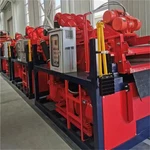

Hey there! As a supplier of pile breakers, I often get asked about the energy - saving effect of these machines. So, I thought I'd write this blog to share some insights on the topic.
Let's first understand what a pile breaker is. A pile breaker is a piece of equipment used in construction projects to break off the excess length of piles. Piles are long, slender columns made of concrete, steel, or timber, which are driven into the ground to provide foundation support for buildings, bridges, and other structures. After the piles are installed, the top part that extends above the required level needs to be removed, and that's where a pile breaker comes in.
Now, let's dive into the energy - saving effect. One of the main energy - saving aspects of modern pile breakers is their design. Many of the pile breakers we offer, like the Hydraulic Pile Breaker, are hydraulically powered. Hydraulic systems are known for their high efficiency. They can convert a large percentage of the input energy into useful work. Unlike some older mechanical systems that lose a significant amount of energy through friction and heat, hydraulic pile breakers can operate with much less wasted energy.
For example, when a hydraulic pile breaker is working, the hydraulic fluid transfers the force from the power source to the breaking jaws. The fluid is incompressible, which means that almost all of the energy applied to the fluid is used to move the jaws and break the pile. This is in contrast to mechanical systems where a lot of energy is used just to overcome the resistance in the moving parts.
Another energy - saving feature is the precise control that modern pile breakers offer. With advanced control systems, operators can adjust the force and speed of the breaking action according to the specific requirements of the pile. For instance, if a pile is made of a softer material, the operator can reduce the force applied by the pile breaker. This not only saves energy but also reduces wear and tear on the equipment.
The Excavator Pile Breaker is a great example of this. It can be easily attached to an excavator, and the operator can use the excavator's control system to precisely control the pile - breaking process. This way, there's no need to over - exert the machine, which would waste energy.
Let's talk about the impact on the overall construction project. Using an energy - efficient pile breaker can lead to significant cost savings over the long term. Energy costs are a major part of any construction project budget. By using a pile breaker that consumes less energy, construction companies can reduce their electricity or fuel bills. This is especially important for large - scale projects where pile breaking is a time - consuming and energy - intensive task.
Moreover, energy - efficient pile breakers are also better for the environment. They produce fewer greenhouse gas emissions compared to less efficient equipment. In today's world, where environmental sustainability is a top priority, using energy - saving equipment can help construction companies meet their environmental goals.
Now, let's look at a specific product, the 1000mm Foundation Pile Breaker. This pile breaker is designed to handle large - diameter piles. Despite its size, it has been engineered to be energy - efficient. It uses a combination of advanced hydraulic technology and intelligent control systems to ensure that it breaks the piles with the minimum amount of energy.
The 1000mm Foundation Pile Breaker also has a modular design. This means that it can be easily customized for different projects. If a project requires a different configuration, the operator can quickly adjust the pile breaker without having to use a lot of extra energy for re - engineering or re - assembly.
In addition to the energy - saving features of the pile breakers themselves, our company also provides training to operators. We believe that proper operation is crucial for maximizing the energy - saving effect. Our training programs teach operators how to use the pile breakers in the most energy - efficient way. For example, they learn how to position the pile breaker correctly, how to adjust the settings according to the pile conditions, and how to perform regular maintenance to keep the equipment running at peak efficiency.
When it comes to maintenance, our pile breakers are designed to be easy to maintain. Regular maintenance is essential for energy efficiency. A well - maintained pile breaker will operate more smoothly and use less energy. For instance, keeping the hydraulic fluid clean and at the right level, and ensuring that the breaking jaws are sharp and in good condition can all contribute to better energy performance.
We also offer remote monitoring services for our pile breakers. This allows us to keep track of the machine's performance in real - time. If we notice any signs of inefficiency, such as abnormal energy consumption, we can alert the operator and provide advice on how to fix the problem. This proactive approach helps to ensure that the pile breakers are always operating at their best in terms of energy efficiency.
In conclusion, the energy - saving effect of our pile breakers is significant. From the advanced hydraulic technology to the precise control systems and easy - to - maintain design, every aspect of our pile breakers is engineered to reduce energy consumption. Whether you're a small construction company working on a local project or a large - scale contractor handling a major infrastructure development, our pile breakers can help you save money on energy costs and reduce your environmental impact.
If you're interested in learning more about our pile breakers or discussing your specific project requirements, I encourage you to reach out to us. We're always happy to have a chat and see how we can help you with your pile - breaking needs.
References


- Construction Equipment Handbook: Covers general information about construction machinery and their energy - related aspects.
- Hydraulic Systems Engineering Manual: Details the principles and efficiency of hydraulic systems used in pile breakers.