

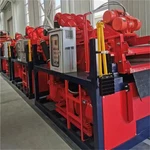

As a supplier of Slurry Desanders, I often get asked about the maximum slurry viscosity that our equipment can handle. This is a crucial question, as viscosity plays a significant role in the performance and efficiency of a slurry desander. In this blog post, I will delve into the concept of slurry viscosity, its impact on desander operation, and the maximum viscosity our Slurry Desanders can effectively manage.


Understanding Slurry Viscosity
Viscosity is a measure of a fluid's resistance to flow. In the context of slurries, which are mixtures of solids and liquids, viscosity is influenced by several factors. These include the concentration of solids, the size and shape of the solid particles, the type of liquid carrier, and the temperature. A higher concentration of solids generally leads to increased viscosity, as the particles interact more with each other and the liquid, impeding flow. Similarly, larger or irregularly shaped particles can cause more friction and increase viscosity.
The type of liquid carrier also matters. For example, a slurry with a water - based carrier will typically have a different viscosity compared to one with an oil - based carrier. Temperature is another critical factor; as temperature increases, the viscosity of most slurries decreases because the increased thermal energy allows the particles and liquid molecules to move more freely.
Importance of Viscosity in Slurry Desander Operation
A slurry desander, also known as a Slurry Desander, is a device used to separate sand and other coarse solids from a slurry. It operates based on the principle of centrifugal force. The slurry is pumped into the desander at high speed, creating a swirling motion. The centrifugal force causes the heavier solid particles to move towards the outer wall of the desander and be discharged through the underflow, while the lighter liquid and finer particles exit through the overflow.
Viscosity affects this process in several ways. High - viscosity slurries have a greater resistance to flow, which can lead to reduced flow rates through the desander. This may result in longer residence times of the slurry inside the desander, potentially affecting the separation efficiency. Additionally, the increased friction in high - viscosity slurries can cause more wear and tear on the desander components, such as the cyclone liners and the pump.
On the other hand, if the viscosity is too low, the solid particles may not be effectively separated. The centrifugal force may not be sufficient to overcome the forces keeping the particles suspended in the liquid, leading to poor separation performance.
Maximum Slurry Viscosity Our Slurry Desanders Can Handle
Our company's Slurry Desanders are designed to handle a wide range of slurry viscosities. Through extensive research and development, as well as real - world testing, we have determined that our standard desanders can effectively handle slurries with viscosities up to approximately 100 centipoise (cP).
This maximum viscosity is based on a combination of factors, including the design of the cyclone, the material of the liners, and the power of the pump. Our cyclones are engineered to create a strong and stable swirling motion, even with relatively high - viscosity slurries. The liners are made from high - wear - resistant materials that can withstand the increased friction associated with high - viscosity slurries. And our pumps are selected to provide sufficient pressure and flow rate to ensure proper operation of the desander.
However, it's important to note that the maximum viscosity can vary depending on the specific application and the characteristics of the slurry. For example, if the slurry contains a high proportion of large or abrasive particles, the effective maximum viscosity may be lower due to increased wear on the components. In such cases, we may recommend additional wear - protection measures or custom - designed desanders.
Factors Affecting the Maximum Viscosity
Several factors can influence the actual maximum viscosity that a slurry desander can handle in a particular application:
Solid Concentration
As mentioned earlier, a higher solid concentration generally leads to higher viscosity. If the solid concentration in the slurry is very high, it may exceed the desander's capacity even if the viscosity is within the nominal range. In such cases, pre - dilution of the slurry may be necessary to reduce the viscosity and improve the separation efficiency.
Particle Size and Shape
Large or irregularly shaped particles can increase the viscosity and also cause more wear on the desander. If the slurry contains a significant amount of such particles, the desander may need to be operated at a lower viscosity to ensure proper performance and longevity.
Temperature
Temperature has a significant impact on viscosity. In cold environments, the viscosity of the slurry may increase, potentially exceeding the desander's capacity. In such cases, heating the slurry or using additives to reduce the viscosity may be required.
Testing and Optimization
To determine the optimal operating conditions for a specific slurry, we offer testing services. Our team of experts will collect a sample of the slurry and conduct a series of tests in our laboratory. We will measure the viscosity, solid concentration, particle size distribution, and other relevant parameters. Based on the test results, we can recommend the most suitable desander model and operating conditions, including the maximum allowable viscosity.
We also provide on - site support to optimize the performance of our desanders. Our technicians will visit the customer's site, monitor the operation of the desander, and make any necessary adjustments to ensure that it is operating at its best.
Applications and Industry Examples
Slurry desanders are widely used in various industries, including mining, oil and gas, and wastewater treatment.
In the mining industry, slurries are often highly viscous due to the high concentration of solids. Our Slurry Desanders are used to separate sand and other coarse particles from the ore slurry, improving the efficiency of downstream processing. For example, in a gold mining operation, the desander can remove large sand particles from the slurry before it enters the flotation cells, reducing the wear on the equipment and improving the recovery rate.
In the oil and gas industry, Mud Desanders are used to separate solids from drilling mud. The viscosity of drilling mud can vary depending on the type of additives used and the depth of the well. Our desanders can effectively handle the typical viscosities encountered in drilling operations, ensuring the proper functioning of the drilling equipment and reducing the environmental impact of the waste mud.
In wastewater treatment, slurry desanders are used to remove sand and grit from the incoming wastewater. The viscosity of the wastewater can be affected by the presence of organic matter and other contaminants. Our desanders can handle a range of viscosities, helping to improve the efficiency of the treatment process.
Conclusion
The maximum slurry viscosity that a slurry desander can handle is an important consideration in its operation. Our Slurry Desanders are designed to handle viscosities up to approximately 100 cP, but this can vary depending on the specific application and slurry characteristics. Through testing and optimization, we can ensure that our desanders operate at their best in a wide range of conditions.
If you are in need of a slurry desander for your application, we encourage you to contact us for a consultation. Our team of experts will work with you to understand your requirements and recommend the most suitable solution. Whether you are in the mining, oil and gas, or wastewater treatment industry, we have the experience and expertise to provide you with a high - quality desander that meets your needs.
References
- Smith, J. (2018). "Centrifugal Separation in Slurry Processing". Journal of Industrial and Engineering Chemistry.
- Johnson, A. (2019). "Viscosity Effects on Cyclone Separation Efficiency". Proceedings of the International Conference on Separation Technology.
- Brown, R. (2020). "Optimizing Slurry Desander Performance". Mining Engineering Magazine.