


What is the Poisson's ratio of a rotary casing tube?
As a reputable supplier of rotary casing tubes, I am often asked about various technical aspects of these products, and one question that frequently comes up is about the Poisson's ratio of a rotary casing tube. In this blog, I will delve into what the Poisson's ratio is, its significance for rotary casing tubes, and how it impacts the performance of these essential components in various construction and industrial applications.
Understanding Poisson's Ratio
The Poisson's ratio, named after the French mathematician Siméon Denis Poisson, is a fundamental property of materials that describes how a material responds to an applied load in terms of lateral (transverse) and longitudinal (axial) deformation. When a material is subjected to a uniaxial load, it not only changes its length in the direction of the load but also in the perpendicular directions. The Poisson's ratio, denoted by the Greek letter nu (ν), is defined as the negative ratio of the transverse strain to the longitudinal strain:
ν = -ε_transverse / ε_longitudinal
where ε_transverse is the transverse strain (change in width or diameter per original width or diameter) and ε_longitudinal is the longitudinal strain (change in length per original length).
The Poisson's ratio is a dimensionless quantity, and its value typically ranges from -1 to 0.5 for most engineering materials. For isotropic materials, which have the same mechanical properties in all directions, the theoretical upper limit of the Poisson's ratio is 0.5. Rubber is an example of a material that can approach this upper limit, as it can expand significantly in the transverse direction when stretched longitudinally. On the other hand, cork has a Poisson's ratio close to zero, meaning it hardly changes its shape in the transverse direction when compressed.
Poisson's Ratio of Rotary Casing Tubes
Rotary casing tubes are typically made of steel, which is an anisotropic material, meaning its mechanical properties vary depending on the direction. The Poisson's ratio of steel typically ranges from 0.25 to 0.33. This value indicates that when a steel rotary casing tube is subjected to an axial load, it will contract in the transverse direction by about 25% to 33% of the amount it elongates or shortens in the axial direction.
The Poisson's ratio of a rotary casing tube is an important parameter because it affects the tube's response to external loads, such as pressure, torsion, and bending. For example, when a casing tube is subjected to internal pressure, the Poisson's ratio determines how much the tube will expand radially. A higher Poisson's ratio means that the tube will expand more in the radial direction for a given internal pressure, which can affect the tube's ability to maintain its integrity and withstand the load.
In addition, the Poisson's ratio also plays a role in the tube's resistance to buckling. Buckling is a phenomenon that occurs when a slender structure, such as a casing tube, suddenly loses its stability under an axial compressive load. The Poisson's ratio affects the critical buckling load of the tube, which is the maximum load that the tube can withstand before buckling occurs. A lower Poisson's ratio can increase the critical buckling load, making the tube more resistant to buckling.

Importance of Poisson's Ratio in Rotary Casing Tube Applications
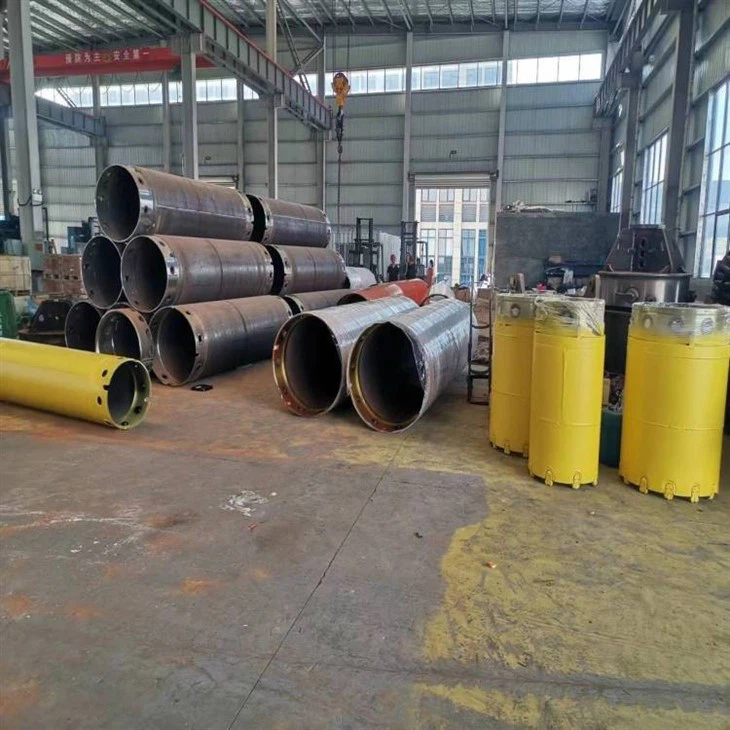
Rotary casing tubes are widely used in various construction and industrial applications, such as foundation construction, oil and gas drilling, and geotechnical engineering. In these applications, the Poisson's ratio of the casing tube can have a significant impact on the performance and safety of the overall system.
For example, in Foundation Construction Temp Casing Tube, casing tubes are used to support the excavation and provide a stable environment for the installation of foundation piles. The Poisson's ratio of the casing tube affects the lateral pressure distribution around the tube, which can impact the stability of the excavation and the performance of the foundation piles. A higher Poisson's ratio can result in increased lateral pressure, which may require additional support or reinforcement to prevent soil movement and pile failure.
In oil and gas drilling, casing tubes are used to line the wellbore and prevent the collapse of the surrounding rock formations. The Poisson's ratio of the casing tube affects its ability to withstand the high pressures and stresses encountered during drilling operations. A lower Poisson's ratio can improve the tube's resistance to collapse and ensure the integrity of the wellbore.
In geotechnical engineering, casing tubes are used for soil sampling, ground improvement, and monitoring. The Poisson's ratio of the casing tube can affect the accuracy of soil test results and the performance of ground improvement techniques. For example, when using a 2500mm Double Wall Temporary Casing Pipe for soil sampling, the Poisson's ratio of the tube can influence the stress distribution around the sampling area, which can affect the quality of the soil sample.
Factors Affecting the Poisson's Ratio of Rotary Casing Tubes
The Poisson's ratio of a rotary casing tube can be influenced by several factors, including the material properties, manufacturing process, and operating conditions.
- Material Properties: The Poisson's ratio is primarily determined by the atomic and molecular structure of the material. Different types of steel have slightly different Poisson's ratios, depending on their composition and microstructure. For example, high-strength steels may have a slightly lower Poisson's ratio compared to low-strength steels due to their different crystal structures and alloying elements.
- Manufacturing Process: The manufacturing process can also affect the Poisson's ratio of the casing tube. For example, cold working, such as rolling or drawing, can change the microstructure of the steel and alter its mechanical properties, including the Poisson's ratio. Heat treatment, such as annealing or quenching, can also have an impact on the Poisson's ratio by modifying the crystal structure of the steel.
- Operating Conditions: The operating conditions, such as temperature, pressure, and loading rate, can also influence the Poisson's ratio of the casing tube. For example, at high temperatures, the atomic and molecular structure of the steel may change, leading to a change in the Poisson's ratio. Similarly, high pressures and loading rates can cause the material to deform in a different way, affecting the Poisson's ratio.
Measuring the Poisson's Ratio of Rotary Casing Tubes
Measuring the Poisson's ratio of a rotary casing tube typically involves conducting a uniaxial tension or compression test on a sample of the tube material. During the test, the axial and transverse strains are measured using strain gauges or other measuring devices, and the Poisson's ratio is calculated using the formula mentioned earlier.
It is important to note that the Poisson's ratio measured in the laboratory may not be exactly the same as the actual Poisson's ratio of the casing tube in the field. This is because the operating conditions in the field, such as temperature, pressure, and loading rate, may be different from those in the laboratory, which can affect the material's response and the Poisson's ratio.
Conclusion
The Poisson's ratio is an important property of rotary casing tubes that affects their response to external loads and their performance in various construction and industrial applications. As a Bored Pile Casing Tube supplier, we understand the significance of the Poisson's ratio and its impact on the quality and reliability of our products. We ensure that our casing tubes are made of high-quality materials and manufactured using advanced processes to maintain consistent Poisson's ratio values and meet the specific requirements of our customers.
If you are in need of high-quality rotary casing tubes for your next project, we invite you to contact us for a detailed discussion. Our team of experts is ready to assist you in selecting the right casing tube for your application and providing you with the technical support you need. Don't hesitate to reach out to us for a quote or to learn more about our products and services.
References
- Callister, W. D., & Rethwisch, D. G. (2010). Materials Science and Engineering: An Introduction. Wiley.
- Timoshenko, S. P., & Goodier, J. N. (1970). Theory of Elasticity. McGraw-Hill.
- ASTM International. (2016). Standard Test Methods for Tension Testing of Metallic Materials. ASTM E8/E8M - 16a.