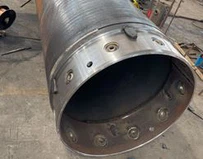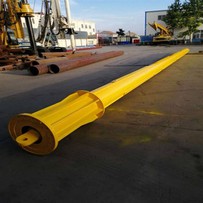


What is double wall casing tube?
-Hyper Drill manufactures double wall casings with joints made through a special rolling-forging process using an extremely high strength, wear-resistant steel alloy. In order to provide adequate structural capacity against torsion, especially when the double wall casings are used in conjunction with casing oscillators and rotators, steel bars fabricated in the shape of spirals are painstaking welded to the inner side of the outer casing tube (for 620mm casings, the steel bars are welded to the outer side of the inner casing tube).
- Inner Tube: The inner tube of double-walled casing is typically smaller in diameter and is inserted into the borehole or well during drilling. Its primary purpose is to house and protect the drilling tool or sampling equipment, such as a drill bit or a coring device. The inner tube allows for the extraction of core samples or the advancement of the drilling tool while preventing the borehole walls from collapsing.
- Outer Tube: The outer tube is the larger, outer layer of the casing system. It serves as a protective barrier surrounding the inner tube and provides structural support to the borehole or well. The outer tube helps prevent the borehole from caving in, especially in loose or unconsolidated geological formations. It also helps maintain the integrity of the borehole during drilling operations.
- Space Between Tubes: The space or annular gap between the inner and outer tubes can be used for various purposes. It may be used for drilling fluid circulation, which helps flush cuttings out of the borehole and maintain pressure control. Additionally, this space can sometimes be used for grouting or sealing to prevent fluid migration in certain applications.
We Offer Double Wall Casings 620mm to 2500mm Diameter
|
Diameter |
Length |
Casing-wall Thickness-1 |
Casing-wall Thickness-1 |
Total Thickness |
Bolt QTY |
|||||
|
D1/D2 |
1m |
2m |
3m |
4m |
5m |
6m |
a1 |
a2 |
t2 |
bolts |
|
(mm) |
Weight(kg) |
(mm) |
(mm) |
(mm) |
(nos) |
|||||
|
620/540 |
403 |
739 |
1074 |
1411 |
1747 |
2081 |
12 |
8 |
40 |
8 |
|
750/670 |
492 |
902 |
1311 |
1722 |
2131 |
2540 |
12 |
8 |
40 |
10 |
|
880/800 |
585 |
1069 |
1552 |
2036 |
2520 |
3005 |
12 |
8 |
40 |
10 |
|
1000/920 |
669 |
1221 |
1773 |
2328 |
2877 |
3429 |
12 |
8 |
40 |
10 |
|
1180/1100 |
844 |
1580 |
2316 |
3052 |
3787 |
4522 |
16 |
8 |
40 |
12 |
|
1200/1120 |
872 |
1620 |
2370 |
3120 |
3870 |
4620 |
16 |
8 |
40 |
12 |
|
1300/1220 |
933 |
1746 |
2558 |
3372 |
4184 |
4996 |
16 |
8 |
40 |
12 |
|
1500/1400 |
1433 |
2628 |
3817 |
5009 |
6210 |
7393 |
20 |
10 |
50 |
12 |
|
1800/1700 |
1730 |
3166 |
4602 |
6038 |
7474 |
8910 |
20 |
10 |
50 |
16 |
|
2000/1880 |
2450 |
4280 |
6110 |
7940 |
9770 |
11600 |
20 |
15 |
60 |
16 |
|
2200/2080 |
2700 |
4720 |
6740 |
8760 |
10780 |
12800 |
20 |
15 |
60 |
16 |
|
2500/2380 |
2960 |
5240 |
7520 |
9800 |
12080 |
14360 |
20 |
15 |
60 |
16 |
※Other size can be customized as per customer demand
How are the double wall casings installed ?
Casing is a large diameter pipe that is assembled and inserted into a recently drilled section of a borehole. Similar to the bones of a spine protecting the spinal cord, casing is set inside the drilled borehole to protect and support the wellstream.
The installation of foundation construction casing tubes is a critical part of ensuring the stability and integrity of deep foundation projects. The process involves several key steps and requires careful planning and execution. Here's a detailed overview of the installation process:
Installation Process
1. Site Preparation
- Site Survey: Conduct a thorough survey of the site to understand soil conditions and identify any potential obstacles.
- Equipment Setup: Mobilize and set up drilling rigs, casing oscillators, or rotators, and other necessary equipment at the site.
2. Drilling the Borehole
- Drilling: Use a drilling rig to create the borehole to the required depth and diameter. The drilling method (e.g., rotary drilling, auger drilling) will depend on the soil type and project specifications.
- Slurry Use: In some cases, drilling slurry (bentonite or polymer) may be used to stabilize the borehole walls and prevent collapse.
3. Insertion of the Casing Tube
- Alignment: Position the casing tube above the borehole, ensuring it is properly aligned.
- Insertion: Lower the casing tube into the borehole using a crane or drilling rig. The tube should fit snugly against the borehole walls.
- Driving or Rotating: Depending on the soil conditions, the casing tube may be driven into place using a vibratory hammer or rotated into position using a casing oscillator or rotator.
4. Securing the Casing Tube
- Stabilization: Ensure the casing tube is stable and correctly positioned. In some cases, additional support or bracing may be used.
- Checking Alignment: Verify that the casing tube is vertically aligned and properly seated in the borehole.
5. Drilling Inside the Casing Tube**
- Continued Drilling: If the casing tube is temporary, continue drilling inside the casing tube to reach the final depth. This step may involve removing soil or rock cuttings from inside the casing tube.
6. Reinforcement Installation
- Rebar Cage: Insert the steel reinforcement cage into the borehole inside the casing tube. The cage should be positioned centrally and secured to prevent movement during concreting.
7. Concreting
- Concrete Pouring: Pour concrete into the borehole inside the casing tube. Ensure continuous and uniform flow to avoid segregation and voids.
- Tremie Pipe: Use a tremie pipe if necessary to ensure the concrete reaches the bottom of the borehole without mixing with the drilling slurry or groundwater.
8. Casing Tube Removal (for Temporary Casings)
- Extraction: Once the concrete has been poured and partially set, begin extracting the temporary casing tube. This can be done using a crane or hydraulic extractor.
- Monitoring: Monitor the concrete level during extraction to ensure it remains above the bottom of the casing tube, preventing soil or slurry intrusion.
9. Final Steps
- Curing: Allow the concrete to cure properly, following standard curing practices to achieve the required strength.
- Inspection: Conduct a final inspection to ensure the borehole, reinforcement, and concrete meet the project specifications and quality standards.
Considerations
1. Soil Conditions
- Soft Soil: In soft or loose soils, additional precautions such as using slurry or driving the casing tube deeper may be necessary to prevent collapse.
- Hard Soil/Rock: In harder soils or rock, stronger equipment and methods may be required to insert and secure the casing tube.
2. Environmental Factors
- Groundwater: High groundwater levels may require the use of dewatering techniques or continuous casing to manage water ingress.
- Weather: Weather conditions can affect the drilling and concreting process, so contingency plans should be in place.
3. Safety Measures
- Protective Gear: Ensure all workers wear appropriate protective gear and follow safety protocols.
- Equipment Safety: Regularly inspect and maintain equipment to prevent malfunctions and accidents.
The proper installation of foundation construction casing tubes is essential for the success of deep foundation projects, ensuring stability, safety, and structural integrity.
Advantages
1. Our state-of-the-art manufacturing facility and corporate headquarters span over 20,000 square meters, providing a substantial footprint for innovative production and operational excellence.
2. We source our raw materials from China's premier steel plate suppliers, ensuring that every product we create is of the highest caliber and durability.
3. Our casing connections are crafted with cutting-edge forging and heat treatment processes, setting a new standard in product strength and reliability.
4. Our products have made their mark in over 60 countries and regions worldwide, including the USA, Australia, Canada, New Zealand, Russia, Brazil, Mexico, Southeast Asia, Bangladesh, and Africa, underscoring our extensive global reach and industry acclaim.
Cases


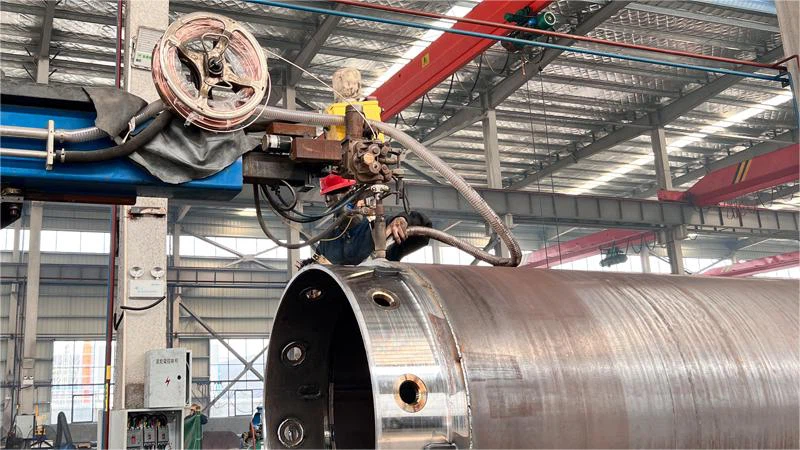
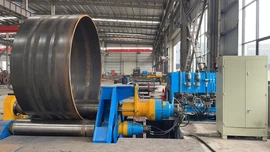
Workshop

Details


Packing and Delivery


FAQ
Q: What is difference between Double wall casing tube and single wall casing tube?
Q: What's the production lead time for 30M length casings?
Q:What's color of casing tube you make?
Q: What exactly is a double wall casing tube?
Q: Why should I use a double wall casing tube instead of a single wall one?
Q: Where's the best place to use a double wall casing tube?
Q: How does a double wall casing tube get into position?
Q: What materials make up a double wall casing tube?
Q: Can I customize a double wall casing tube?
Q: Any things to keep in mind with double wall casing tubes?
Hot Tags: double wall casing tube, China double wall casing tube manufacturers, suppliers, factory, strong casing tube, thin wall casing tube, chemical plant area casing tube, operational casing tube, casing tube, mechanical casing tube